Fat Sal & Fat Jerry – Fat Sal’s Deli, Gayley Ave, Los Angeles, CA

“A taste of New York in Los Angeles” my eye. That was the line on Fat Sal’s deli from a local newspaper, a taste of New York in Los Angeles. I’ve lived in New York. I’ve eaten my share of sandwiches there. New York sandwiches are the reason this blog exists. You know what people who make sandwiches in New York know how to do? They know how to make an appetizing sandwich. There are a variety of ways to do this, but here’s one sure-fire come up short: stuff a hero roll with every blasted thing you can think of. Take the Fat Sal, the namesake sandwich pictured above. A garlic hero struggles to contain roast beef, mozzarella sticks, onion rings, fries, brown gravy and mayonnaise. In an abysmal case of subtraction by addition, that massive pile of stuff turns into an ugly mash of gravy, breading, and mayo. I can’t think of a single place in New York City that would offer me the above.
The Fat Jerry isn’t any better. Cheesesteak, chicken fingers, mozzarella sticks, bacon, fried egg, mayonnaise, ketchup and salt and pepper overwhelm a poor hero roll. Where the Fat Sal tasted of gravy, this one was all breading and egg.

In truth, I saw this coming. The mozzarella sticks are the giveaway. I’m sure mozzarella sticks have a fair place on a sandwich, but I’ve never seen them in any context other than an intentionally wacky, get-a-load-of-this sort of sandwich. It’s a flag, flown high and with pride, signalling that restraint has been abandoned, good sense jettisoned. Aren’t we crazy? mozzarella sticks ask, and I can only think to reply yes, yes you are.

I get that the things I’m complaining about are the entire point of the endeavor, but a bad idea executed as intended is still a bad idea. I dined here with my esteemed associate Bill, who pointed out that for all the ingredients in essence what you had was a bland gravy sandwich and a bland egg sandwich. For such large sandwiches, he remarked, they were surprisingly small. That might be the most damning thing, that for all their swagger, these sandwiches are nothing more than blowhards. I know New York, Sal. New York was very good to me. You’re no taste of New York.

Winston’s Vesper – Big Word Cafe, Saratoga Sunnyvale Rd, Saratoga, CA


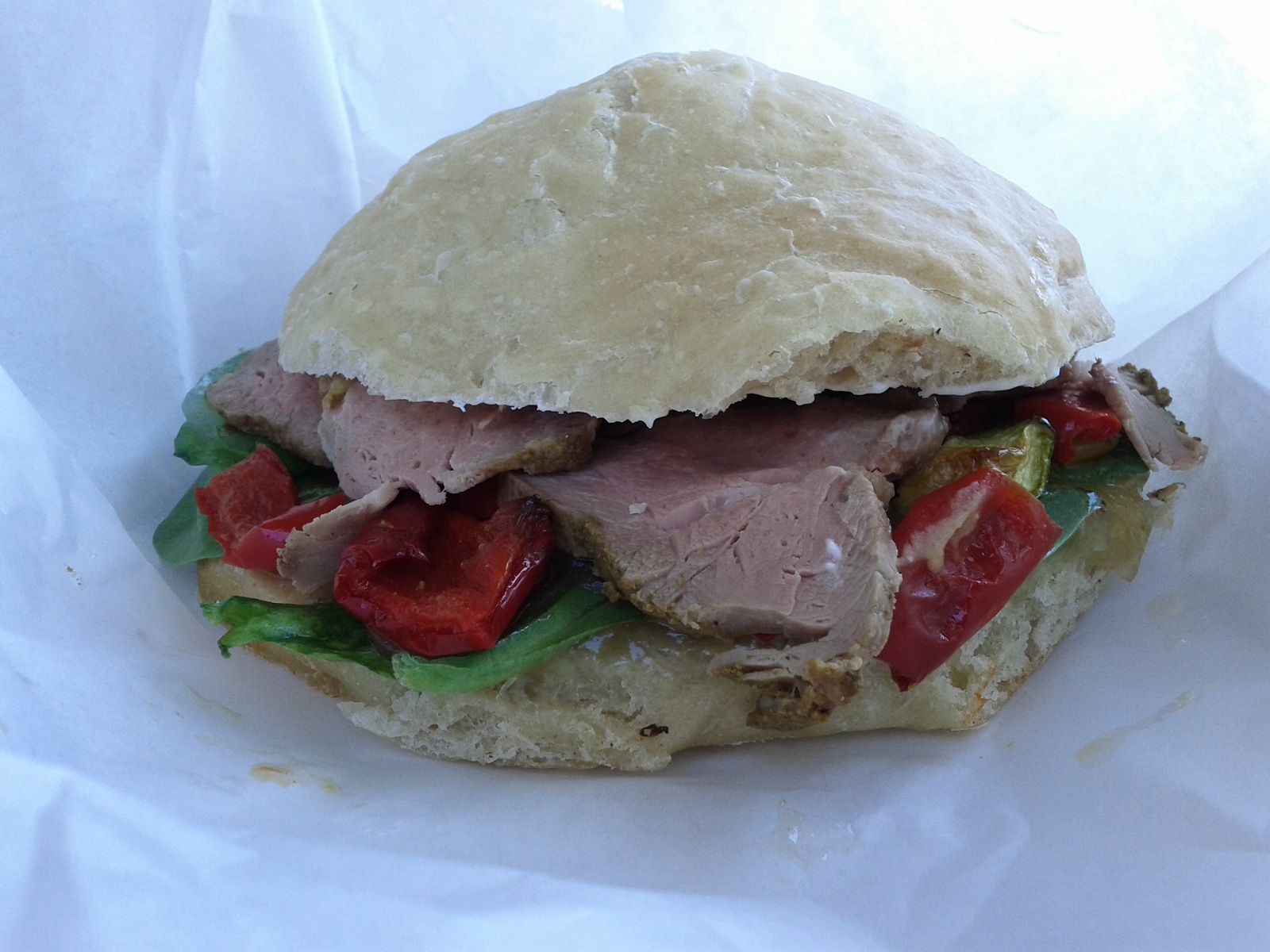
Here we have a fine counter example to Monday’s meager offering of a sandwich. All the way on the other side of town, nearly a dollar and a half less than what I paid at Caffe Frascati nets me a much more satisfying sandwich. A few hearty slices of cumin spiced roast pork, a house made mango ginger chutney, roasted red peppers, cucumbers and spinach all pile on a white roll and come together quite nicely. This was clearly a sandwich from a coffee bar; it was served cold, and alltogether wasn’t quite everything it could have been. It was also missing the clear freshness that benefited the recent sandwich featured from Coach House, but despite all of that it was still quite good. The pork was well seasoned and tender, the chutney sweet with clear hints of ginger cutting through, the spinach a nice earthy undertone. This was just a good example of what I wish places like Caffe Frascati understood: A good sandwich isn’t hard, you just have to try. A little effort goes a long way, and at Big Word Cafe it went all the way to a delicious sandwich.

Mortadella and Goat Cheese Panini – Caffe Frascati, S 1st St, San Jose, CA

Just last week I mentioned that context has an inescapable impact on the sandwich. How it looks, the surrounding atmosphere and our own expectations all influence how we feel about a particular sandwich. That may not be fair to the idea of sandwiches in and of themselves, but we never eat sandwiches in and of themselves. We eat them in the real world.

Some may consider me boorish for it, but I feel obligated to talk about price. The sandwich above retails for $7.95. Now, I’m no country mouse. I’m not at all categorically opposed to paying $8 for a sandwich, provided I get $8 worth of sandwich to enjoy. Sadly, at Caffe Frascati that simply wasn’t the case. I try to sympathize with people trying to make it in an industry that’s ruthless in the best of times, but this is a cafe and not a charity. This was a sandwich with a lot of potential, tangy goat cheese and subtle flavors working together, but with scant few slices of mortadella and the thinnest application of red pepper pesto the whole thing just failed to come together. I can accept a failed sandwich, but it’s hard to be satisfied with a failed $8 sandwich where those eight dollars ended up everywhere but on the plate.

Vege Smoked Duck & Vege Pepper Steak – Love and Haight, Haight St, San Francisco, CA

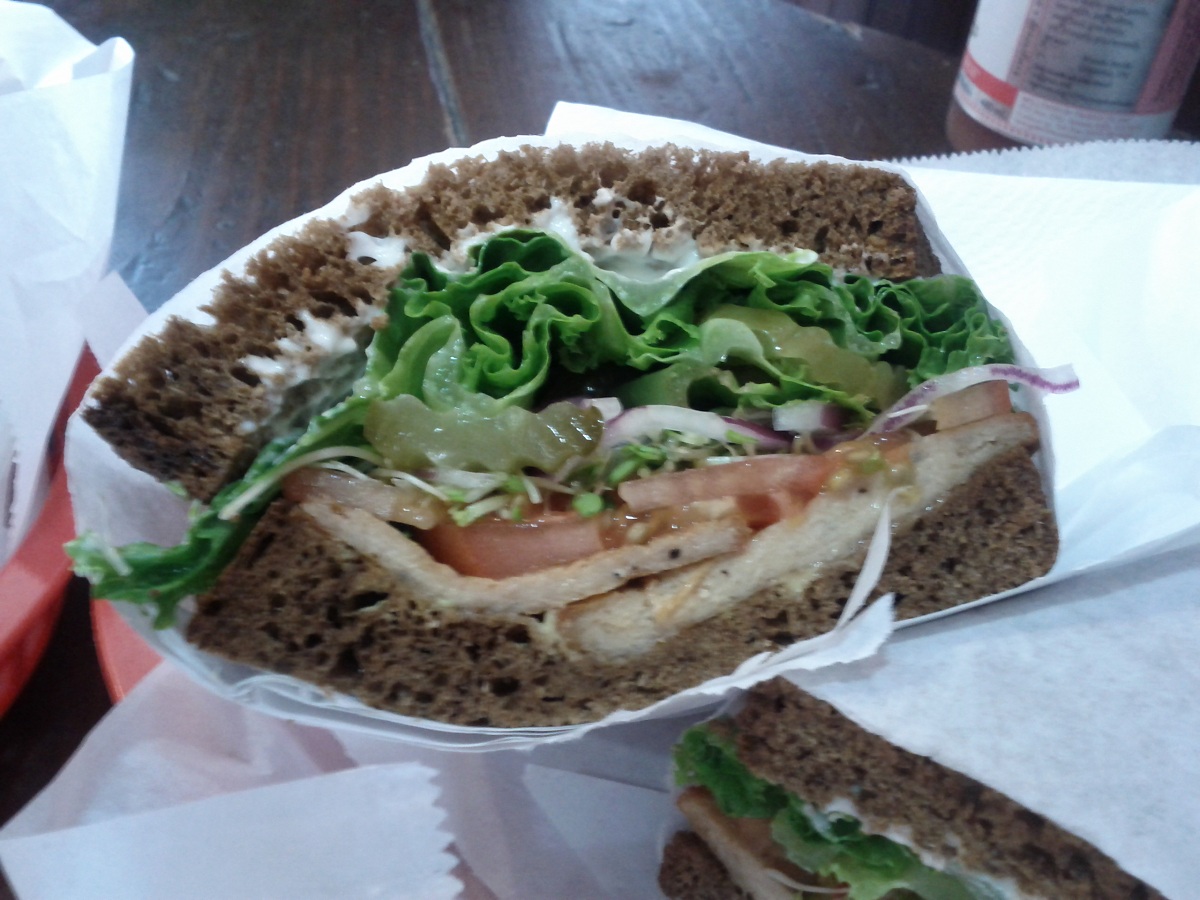
The smoked duck sandwich at Love and Haight is not actually made of duck. Similarly, the pepper steak sandwich involves no actual steak. They are meat substitutes, products where soybeans and other such things are processed to resemble meat. I’ve considered such things before, and ultimately I concluded that they say more about meat than they do about soybeans. (The short of it is that it says an awful lot about cold cuts that you can mash a bunch of soy together and get something that is more-or-less as good.) But what of the things in themselves?

If we consider the most basic question, I should say that the sandwiches are a success. They taste good. The pepper steak was tasty, and the duck was particularly choice. It had a deep, smoky flavor, and the success of the sandwiches definitively credited to how good these flavors were. The accompanying ingredients were lettuce, tomato, pickles, red onions, mayo, mustard and, in owing to the location and the style of the place, sprouts. That’s a classic deli sandwich, but if the main ingredient fails there isn’t much there for backup. In further evidence of the reliance on the fake meat, if one is going to attempt to pass off a facsimile as hey-I-guess-it’s-good-enough, one does not attempt duck. It’s not a fake-it-and-hope-nobody-notices move. That’s important to note, because it points at the whole problem with the sandwich.

I think there’s a framing issue at work here, and while both sandwiches were quite good I’m far from convinced they were everything they could be. Food isn’t just a question of taste and smell. We eat with our eyes, the atmosphere matters, the context has an impact. There’s a lot going into each meal, even if we’re hardly conscious of most of it. What I found myself wondering at Love and Haight was whether I would have enjoyed these sandwiches more had they not been pitched as fake meat. The fake duck was good enough that I was happy to be eating it, but it was a far cry from real duck. Smoked duck is juicy and tender, a product of abundantly fatty tissue. There are a lot of ways to make soybeans delicious, there are very few that will turn them into duck.

Above I asked what was the value of the things in themselves, and I’m not sure I have an answer to that question. I cannot consider them in a context apart from fake meat, they don’t exist in any other context. I don’t know what you would call it, and I don’t know whether I would have ended up there eating it if it wasn’t trying to emulate meat. Those are difficult questions, and I don’t have answers for them. It light of that, I cannot help but think I haven’t given these sandwiches the full consideration they deserve.

The Kaiser – Coach House Liquors and Deli, S De Anaza Blvd, Cupertino, CA

I recently read Tyler Cowen’s An Economist Eats Lunch, and I found it to be an interesting book. It presents a certain way of thinking about food with a heavy focus on thinking about inputs, demand, and how other such market forces might influence things. One of the suggestions is to seek out restaurants where the cost of operation is subsidized by a related enterprise. A family run restaurant attached to a motel owned by the same family is one example, restaurants at the back of a casino another.  Upon realized that Coach House had a well stocked deli counter stuck in the middle of a moderately upscale liquor store, I thought back to Cowen’s advice. The reasoning here is that liquor stores tend to do good business, and therefore there would be less pressure on the restaurant to squeeze the maximum profits out of everything. That’s where you run into pre-packaged avocado spreads, tired and wilted veggies, that sort of horror. And indeed, that’s what I found: the gentlemen manning the sandwich counter told me everything was cut fresh for the day, nothing was packaged. Subsidized by the surrounding liquor, the risk of wasting some food isn’t such a dire threat to the owner’s margins, and a better sandwich than might otherwise be had is the result.

The Kaiser is corned beef and pastrami, swiss cheese, lettuce, tomato and pickled jalapeños, and it was a fine sandwich. What seems logically reasonable holds true in practice. The ingredients were fresh, the price fair, everything you might expect from an establishment with some relief from the pressure faced by most. Thinking about it, this isn’t the first time this thinking has yielded me a fine meal. Bibo’s NY Pizza, one of the better places to get a slice in San Jose, was formerly located off the back of a liquor store. My own beloved Bánh Mì Saigon is in the back half of a jewelry store. This isn’t your average way to find a fine sandwich, looking around for something that might be riding some other business’ coat tails, but I suggest to you that if it results in a sandwich as tasty as the above it’s as fine a way to search as any.

Tomato Sandwiches Three Ways – Made at Home

There’s a bit of news about the tomato making the rounds. It’s interesting enough, but it seems to be something of a science flag planted on a mountain of personal experience:

The mass-produced tomatoes we buy at the grocery store tend to taste more like cardboard than fruit. Now researchers have discovered one reason why: a genetic mutation, common in store-bought tomatoes, that reduces the amount of sugar and other tasty compounds in the fruit.

For the last 70-odd years, tomato breeders have been selecting for fruits that are uniform in color. Consumers prefer those tomatoes over ones with splotches, and the uniformity makes it easier for producers to know when it’s time to harvest.

But the new study, published this week in Science, found that the mutation that leads to the uniform appearance of most store-bought tomatoes has an unintended consequence: It disrupts the production of a protein responsible for the fruit’s production of sugar.


Supermarket tomatoes are terrible. Anyone who has eaten one knows this, and the genetic reason why it’s terrible is just a bit of interesting conversation. Many supermarket tomatoes spend some time in cold storage, which just damanges them further. Refrigerating a tomato destroys aroma volatiles, and given that tomatoes don’t have much flavor to spare to begin with the whole thing is lost. But don’t despair! For many of us there are other sources of tomatoes readily available. Farmer’s markets are increasingly common sights, and at many of these one can find some beautifully colored heirloom tomatoes, rich in taste. After reading the above article I figured the tomato could use some good news, so I picked up a few of these tasty tomatoes and set out to  put together a few sandwiches that didn’t just include tomatoes but featured them. Tomato sandwiches, not sandwiches with tomatoes.

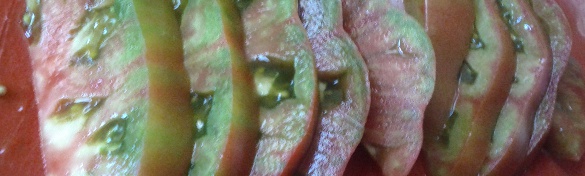
The first sandwich involved the above heirloom tomato, streaked through with greens and purples. Anchovies went down first, then a layer of pan fried cornmeal mush, then the tomatoes. Cornmeal mush is something akin to polenta or grits, just cornmeal and a bit of salt cooked in boiling water, laid in a pan and refrigerated, then sliced and fried. It is bland, but that’s kind of the point. Anchovies are salty as all get out, and I felt the sandwich needed something that would dial them back a bit. The mush did that, but in all honesty it didn’t dial them back quite enough. I like anchovies a lot, but I always feel that if they were 25% less salty they’d be the greatest thing on the face of the earth. The salt is part of the attraction, but as was the case here it’s often just too much. But enough about those two things. The story here is the tomato. This tomato was delicious. What an odd fruit tomato is, that one finds oneself not celebrating that the taste of a tomato is amazing, but rather that the tomato tastes like anything at all. But it was sweet, juicy and firm, and exactly the kind of sandwich around which one builds a sandwich. This could have been better, but with a tomato this good you’re willing to forgive the sandwich a few faults.

The second sandwich was considerably more successful. Another three-ingredient job, a semi-tart orange tomato went on sourdough with avocado and black bean hummus. (The hummus was not much more than toasted garlic, black beans, and a bit of oil to smooth things out.) If I may praise my own doing, this is a strong example of the simple sandwich. It’s something that can be put together in just a few minutes for not much more than the price of cleaning the food processor, and it’s really quite tasty. Nothing involved overshadows the tomato, but the other two ingredients are quite flavorful on their own. In a nice example of why we bother with sandwiches in the first place, three good things go together and become great.

The third sandwich, the second with the heirloom tomato, was significantly more successful than the other. Sweet potato hashbrowns went down first, followed by sliced of tomato, topped by fennel that had been sauteed with garlic. The garlic had fried all the way to little crispy bits, and they were as tasty as you know such things to be. The sweet potato hashbrowns were crispy and had a rich sweetness that worked well with the brighter sweetness of the tomatoes. The fennel, of course, brought its own distinct flavor, and all of that came together in a really tasty sandwich. This isn’t drop-everything-and-try-it material, but if it sounds like something you’d enjoy I give it a strong recommendation. And if it’s been a while since you tasted anything other than the flavorless mush that is a supermarket tomato, I’d say you could find a worse starting point than this sandwich.
Grilled Chicken Sandwich — La Brea Bakery, Downtown Disney, Anaheim, CA

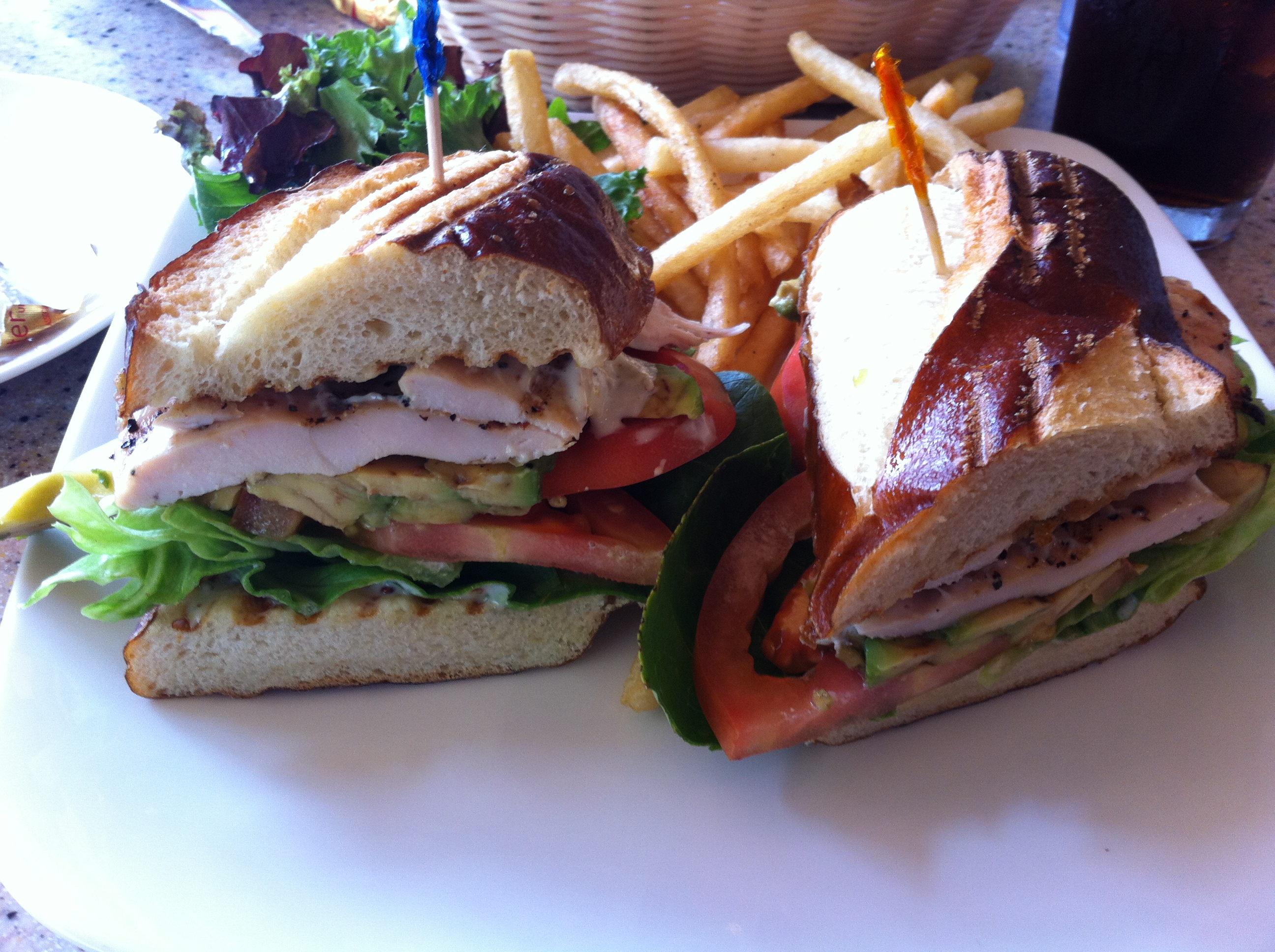
There are times when the sandwich you eat is the perfect sandwich. There are also times when the sandwich you eat is the perfect sandwich for that particular time or occasion. This offering from the La Brea Bakery was possibly both. Recently re-opened just outside of the gates of Disney’s California Adventure, the La Brea Bakery is, naturally, known for its fresh-baked bread. When I saw that one of its items was served on a pretzel roll, I did not hesitate. My adoration for the pretzel roll is, I believe, well-documented on this site.

The sandwich — grilled chicken, butter leaf lettuce, avocado, tomato, and aioli — was fantastic. It was far better than the sum of its parts and its crowing achievement was the pretzel roll, enhancing everything contained therein. Even the inclusion of butter leaf over some of the more preeminent staples of sandwich lettuce was an inspired choice. As I had recently experienced at the Village Bakery and Cafe, the decision to slice the grilled chicken rather than present a complete, boring grilled chicken breast was once again the most correct decision that could have been made.

If there was one problem with this sandwich, it was that there was an unusually high amount of filling creep. But even as by sandwich became messier with each bite, I still marveled at the pleasure derived from eating it. The La Brea Bakery provided me with an unexpected treat on day I sorely needed one.

Grégoire’s Restaurant, Piedmont Ave, Oakland, CA

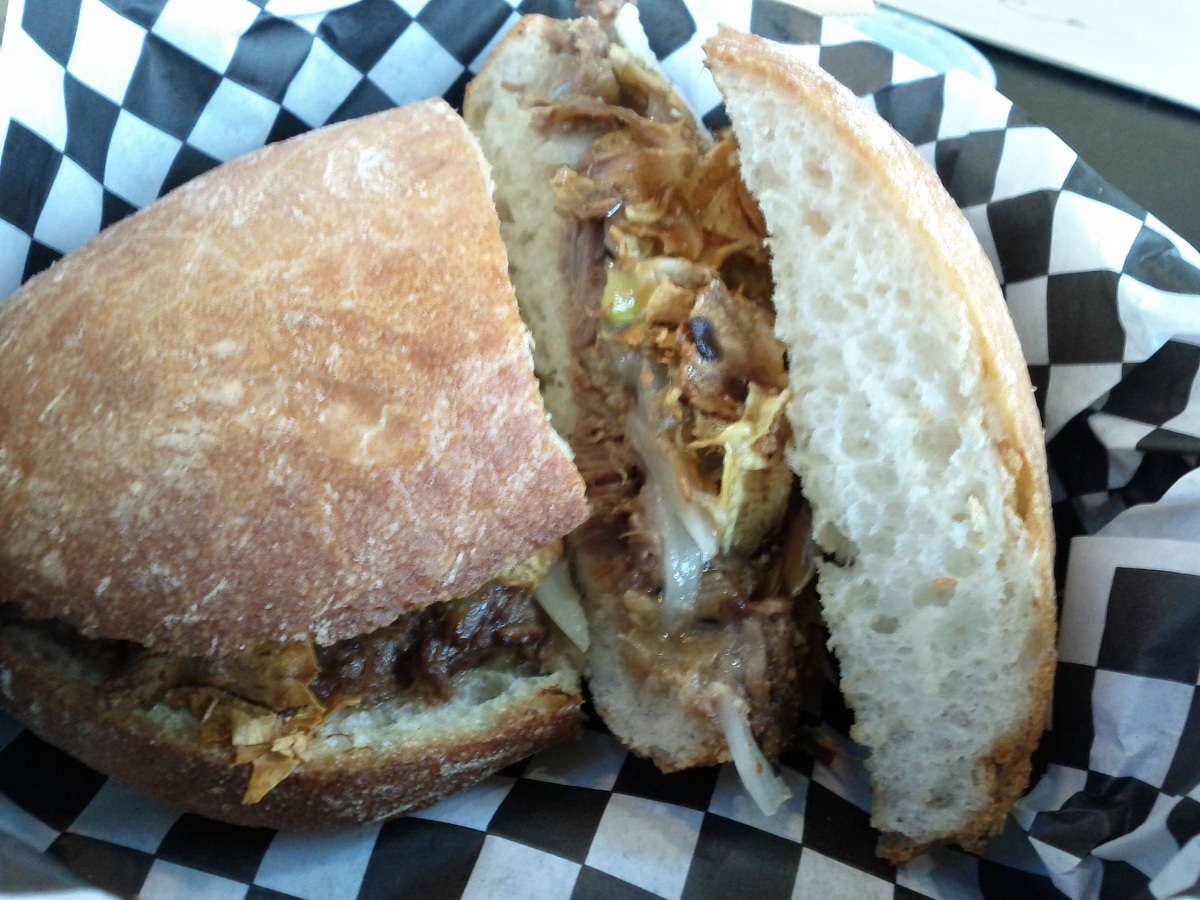
What a pleasure it is, to find an establishment willing to put some effort into the humble sandwich. Part of the joy of sandwiches is how simple they can be; one often needs nothing more than two pieces of bread and a bit of something else to have a fine bite to eat. But another part of the joy of sandwiches is that they really can be taken to some wonderful heights. Such is the case with Grégoire Restaurant, a tiny establishment in Oakland that does brisk takeout business providing “gourmet food made affordable.” Above is the pulled lamb shoulder sandwich: lamb, with espellette pepper, sour onions and artichoke chips on ciabatta. This was an exquisite sandwich, a layering of subtle flavors all built around rich, savory lamb. The artichoke chips were bits of fried artichoke, which brought a bit of crunchy texture to the sandwich with a flavor not typically seen. The onions were not particularly sour and the espellette is a rather mild pepper, leaving the sandwich well balanced and altogether delightful.

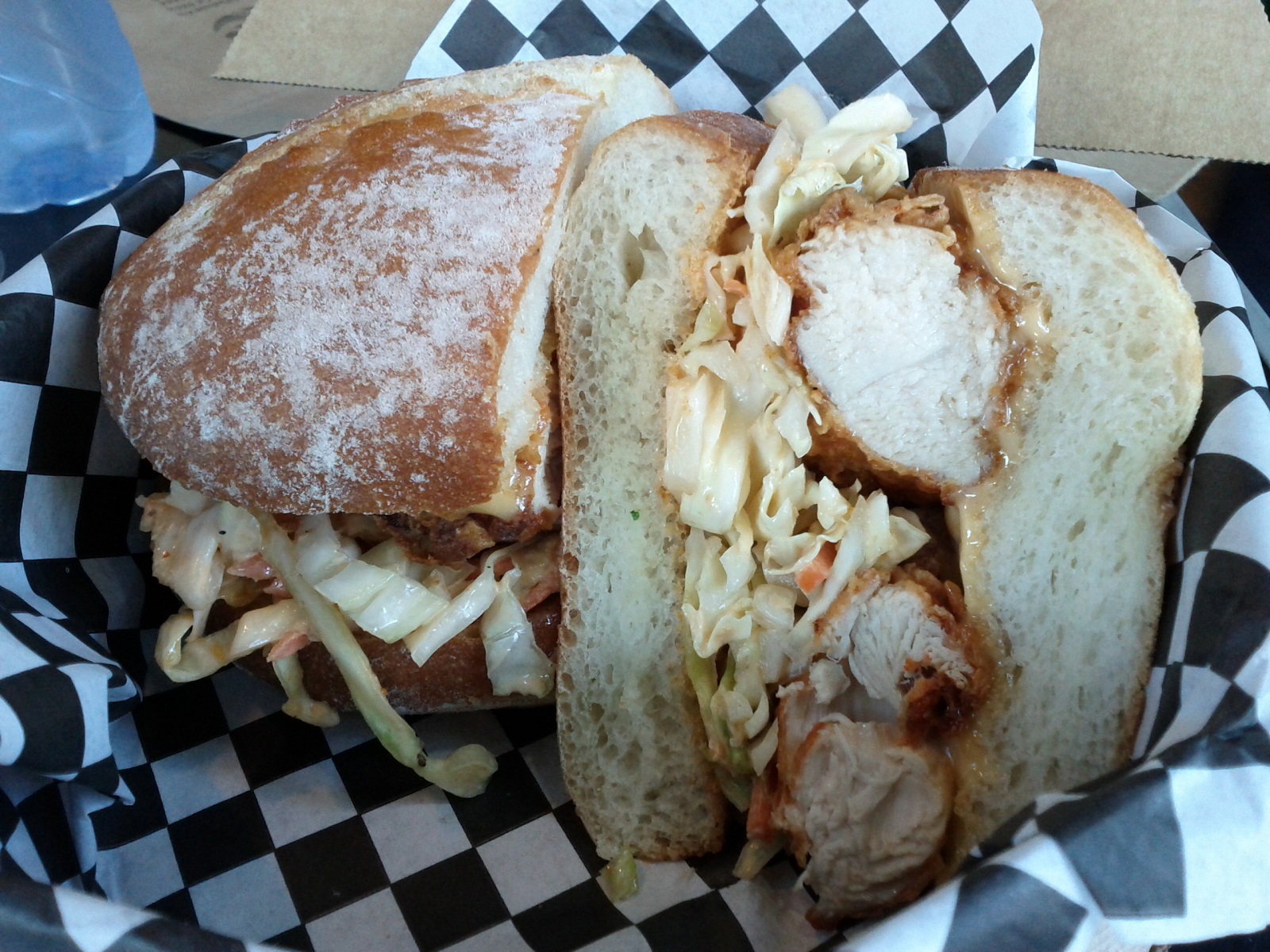
Unfortunately, I did not quite care for the fried chicken sandwich, but I want to make no mark against it. Here we had fried buttermilk chicken with spicy cole slaw on french roll. A simple, honest sandwich. The spice was in the manner of wing sauce, which is far from my favorite heat profile and a big part of what I didn’t enjoy about the sandwich. The chicken was fresh fried, though, the slaw crispy and well paired. The execution was there, and in light of the first sandwich it was clear there was no real failing here, it just wasn’t my style of sandwich. This isn’t a two-ingredient sandwich because someone was lazy or anything of the sort. It’s was that someone put these two things together, saw that it was enough, and was wise enough to stop there. The resulting sandwich wasn’t for me, but it’s easy to see someone else thinking it quite nice. That’s inevitably the result when someone cares, and it’s very clear that someone at Grégoire’s cares very much indeed.

Chipotle Chicken — The Village Bakery & Cafe, Los Feliz Blvd, Los Angeles, CA

As our esteemed founder discovered, the Village Bakery & Cafe is definitely an establishment that knows what it is doing. (Unlike some other establishments we could name.)

The Chipotle Chicken was a very satisfying sandwich that was well worth my time. The sauce was flavorful and not overpowering and the delicious bun both enhanced the experience and masterfully curtailed any danger of filling creep. The true triumph of this sandwich, however, was the simple fact that the chicken was cut into slices. Not deli-thin slices that would more properly called cold cuts, but perhaps twice-filleted and grilled hunks that fitted together to make for a pleasing experience, both in terms of flavor and of texture.

Far too many establishments provide one massive chicken breast flopped from the grill onto a bun and call it a day. Not here. The chicken is purposefully carved and assembled to make for a more pleasing experience. Mission accomplished. It is a simple step and creates a world of difference from the standard chicken breast sandwich. Preferable every time.

The Drippin’s – Poor House Bistro, S Autumn St, San Jose, CA

I talked about the Poor House Bistro some time ago, and what I said then still stands. It’s a fine outpost, a respectable po’ boy in an area where such a thing isn’t in abundance. The reason I bring it up again is to draw a contrast to the Braised Onion French Dip featured on Monday. Both are very good sandwiches, both centered around a big pile of meat, but the things that accompany the Drippin’s are doing something very different than the French Dip from Oaks. Oaks had each ingredient trying to make its own mark: truffled watercress, sherry au jus and braised onions are all an ingredient plus an additional bit of spin. There’s nothing inherently wrong with that, but it makes a sandwich significantly harder to balance; featuring six things is always going to be harder than featuring one thing.

Poor House Bistro takes a more simple approach, in which the support is the support. In addition to the roast pork the sandwich features tomatoes, pickles, shredded cabbage and mustard. That’s not the default “everything,” most sandwiches at Poor House Bistro include mayo by default, but they leave if off the Drippin’s, much to the sandwich’s benefit. Leaving the mayo off gives the cabbage a crisp freshness that pairs quite well with the richness of the pork. This isn’t a question of laziness, it’s just a matter of understanding the sandwich. You’re there for juicy, tender, savory, and just peppery enough pork, and that’s exactly what you get.

I have also tried the BBQ Shrimp Po’ Boy at Poor House Bistro, and it struck me as one of those sandwiches where if it’s your thing, you’ll love it, but if not there isn’t much appealing about it. It’s incredibly heavy on the pepper, and while I do enjoy spicy foods I felt like this was a bit much, one strong note without much support at all. If pepper is your thing, by all means. If you lack that enthusiasm, though, the Drippin’s or one of the fried numbers is likely to set you right.