Banh Mi Thit Kho – Cô Ba, 9th Ave, New York, NY

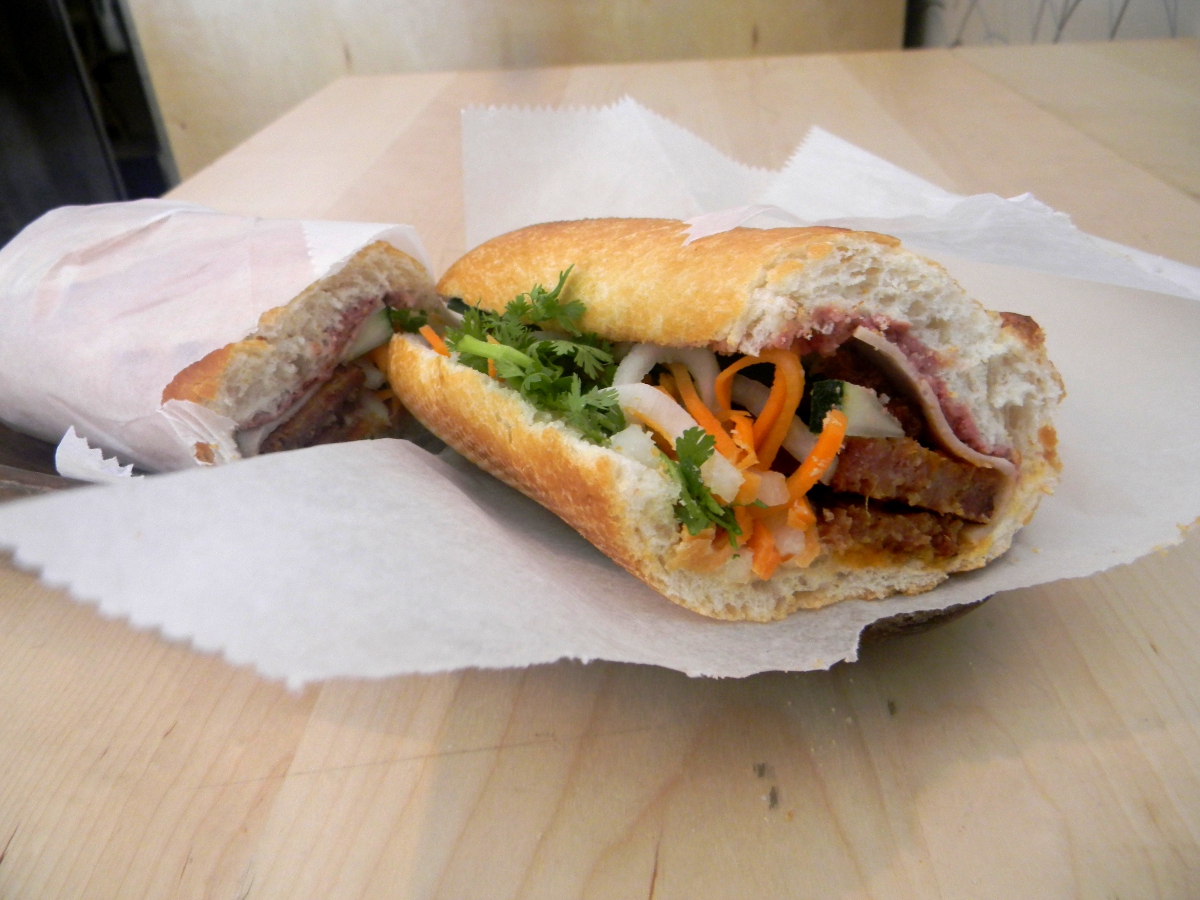
The pork belly bánh mì at Cô Ba sells for $8, which made it the most expensive bánh mì I’d ever seen. In truth were I only pursuing sandwiches for my personal pleasure I’d scoff at such a thing and head over to Chinatown, where a sandwich almost certainly just as good can be had for nearly half the price. But I am in this not just for myself but for a community of enthusiasts, so I swallowed my objections and ordered the sandwich. Besides, perhaps it would be the best bánh mì I’d ever had, a sandwich that would change my life. In that case it might very well be worth the $8! Well, cutting to the chase, it wasn’t worth it. Were I not so accustomed to paying between $4 and $5 for a sandwich I might have no objection at all, but I am and so I do. It was a good sandwich, but no $8.

I would like to make clear, though, it was a good sandwich. Most everything was in the “pretty good” range, better than acceptable but not so good as to be great. The meat was the real highlight, a rich, fatty bit of pork belly. It’s a shame that the jalapeños you see pictured there are the only ones involved. Jalapeños fit better on this bánh mì than any I’ve ever had, the heat cutting the fat nicely. There was a lot more cilantro than average as well, but the pork belly stood up to that just as well as it did the chilies. In the end, it might not be fair to define a sandwich entirely by its price, but nothing exists in a vacuum. Pork belly isn’t something usually offered on a bánh mì, but all sandwiches exist in a larger context and when a short walk will net you a few bucks saved and a better sandwich, it’s hard to get too excited, pork belly or no.

Grilled Pork Patties – Bánh Mì Zớn, E 6th St, New York, NY

There is a reason this sandwich is named in English. Bánh Mì Zòn is highly regarded by New York fans of the bánh mì, and when I was in town I was excited to see what the fuss was. Looking up the address, I was a little bit surprised to find that it was in the East Village. People have called Bánh Mì Zòn home to the best bánh mì in New York City (something with which I would obviously take issue.) Zòn was going to be only the second bánh mì shop I had been to that wasn’t located in a heavily ethnic area. Going in, I was skeptical. Arriving at the shop, my concerns only grew. The shop is new, with tables and stools in an unblemished, unfinished wood. It was…clean. Most bánh mì shops I’ve been to aren’t dirty, exactly. Cluttered might be a better word for it. There’s frequently racks or shelves piled with Vietnamese packaged foods, the signs are often handwritten or printed on 8.5×11″ paper. In general there’s a slipshod quality to them. Bánh Mì Zòn was having none of that, and that’s why the title of this post is in English. This was the first place I’d been to where English seemed to come first.

I don’t have a fetish for authenticity. I’m not going to claim that a good bánh mì can’t be found in non-ethnic neighborhoods. I’m not going to insist you need dust on top of the refrigerator case and an oven missing a dial to make a proper sandwich, and I’m not going to say that anyone who wasn’t enjoying one years ago can’t enjoy one next year. The whole thing just gave me cause to think. I found myself considering the future of the bánh mì. It’s a good sandwich, in the collective sense. That’s no secret, but you run across more people who haven’t had one than people who have, and it’s too good to stay that way. I’m going to bring this up again later this month, but the future of the bánh mì involves significantly more widespread availability. It involves evolution, offshoots and different takes. It involves franchises. I’ve been singing the virtues of the bánh mì to anyone who would listen for a while now, and I’ve been able to do that because I feel like I understand the sandwich. When I recommend that someone try one, I have a certain confidence in what they’re getting. The idea of a future where that isn’t true frightens me.

In a lot of ways this is no different than any other outgrowth of culture. We all come from somewhere, and our people all make something special. Eventually, if we want to share that thing with the world at large, we have to accept that it isn’t always going to be what it was when we first came to love it. I feel a bit ridiculous saying all of this. Obviously I have no personal grounds on which to contest the evolution of the bánh mì — I am only sharing what someone else was kind enough to share with me. But the idea that the thing that I love may someday be completely different is scary. And when I walk into a banh mi shop that looks nothing like virtually every other bánh mì shop I’ve ever been to, it’s hard not to let the mind wander to unsettling places.

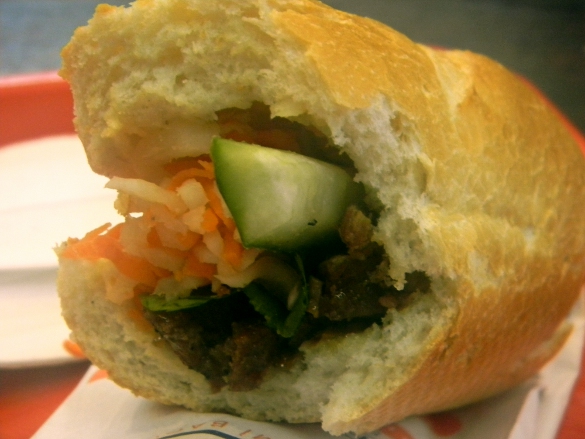
After all of that, my fears remain in a hypothetical future. Bánh Mì Zòn makes a good sandwich, particularly a very good baguette. I don’t think it’s the best in New York City, but I’m not making a straight comparison. The #1 at Zòn is pate, terrine, ham and pork floss. I wanted a more A-to-A comparison, so I got the grilled pork patties, the closest thing to my beloved thịt nướng, frequently referred to as “grilled pork.” Even that turned out to be an unfair comparison, I think. I much prefer the marinated and caramelized bits in thịt nướng, but nem nướng is a different product. It was flavorful and moist, but as I ate it I kept looking at it and thinking of how much surface area had gone ungrilled, how much unfulfilled potential there was for chewy texture and deep flavor. But all in all it’s still a very good sandwich, if you can handle clean floors and new tables.

Bánh Mì Bì – Thanh Huong Sandwich, Senter Rd, San Jose, CA

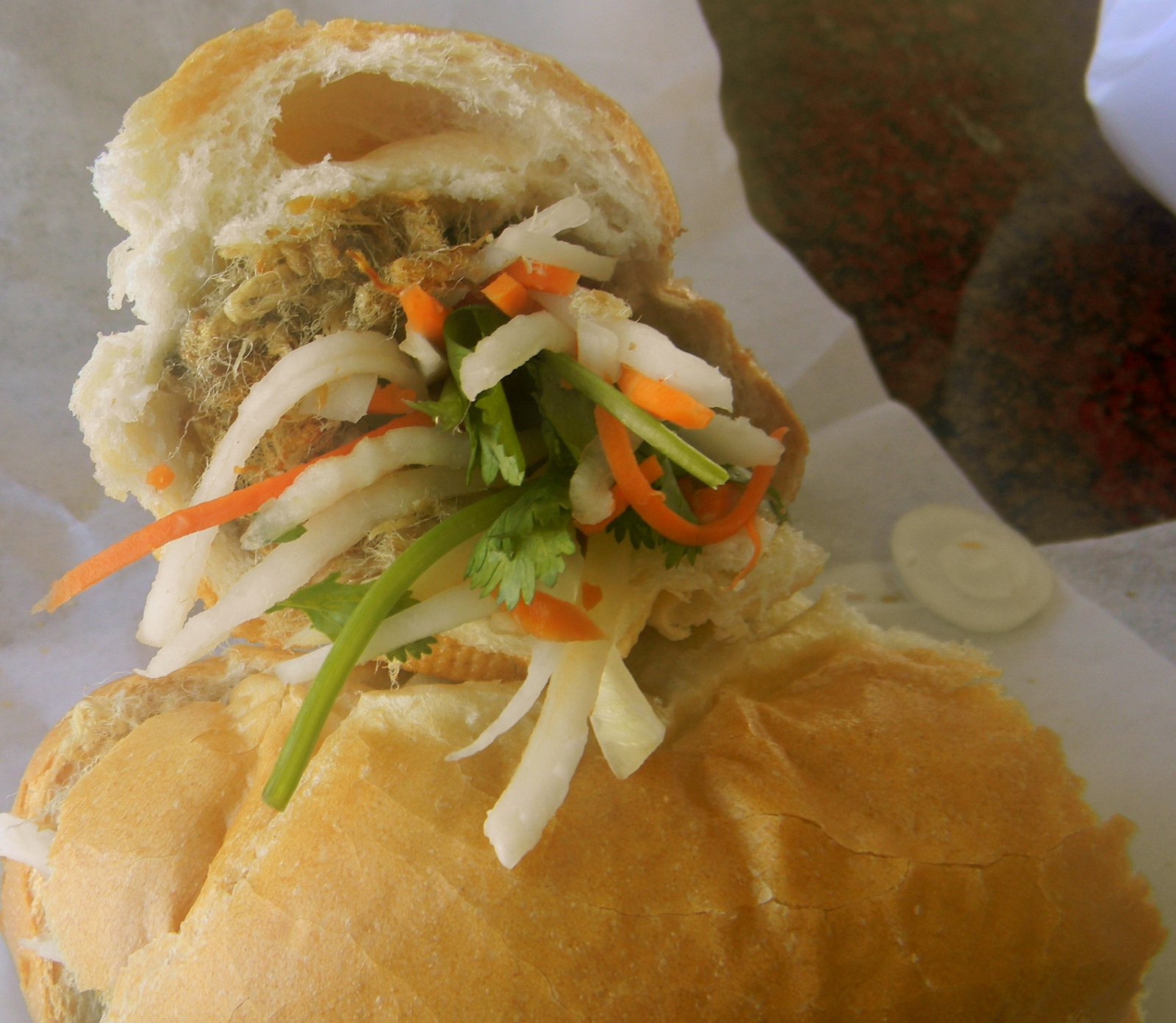
Bì is dry, shredded pork skin. I don’t recall exactly what the menu board at Thanh Huong said, but I am certain it did not include skin. I believe “Roast Pork” was the title. What I found when I sat down to eat my sandwich was not what I was expecting, but what would the world of sandwiches be without surprises? This was my first encounter with bì, but I was excited to try it. Sadly, my excitement was short lived. I found it to be too dry and too salty, and though I understand those are something like features when it comes to bì, this just seemed excessive. That might be my palate; I’ve come to love flavors from all over the world, but I was raised on distinctly American fare. The texture was interesting, and not in an objectionable way. It’s meat floss, and it has a wispy, fine texture worthy of that name. What seems like innumerable strands come together for a dense, very chewy bite. It’s a product that shows up in a number of Asian cuisines, and I would certainly give it another shot. I’d like to try it outside of a sandwich just so I can get a better sense of how things line up. That’s something I think we take for granted when evaluating the sandwich as a whole. We are generally familiar with our ingredients, and knowing what they taste like independently gives us a better sense of how they relate to each other. Operating in unfamiliar territory, that sense can fade quickly. So perhaps the failure here is mine, perhaps it’s the sandwich maker’s. In the end, the only thing of which I can be certain is what was right there in front of me, and that was a disappointing sandwich.

Bánh Mì Thịt Nguội – Long Phung Sandwich & Food, Tully Rd, San Jose, CA

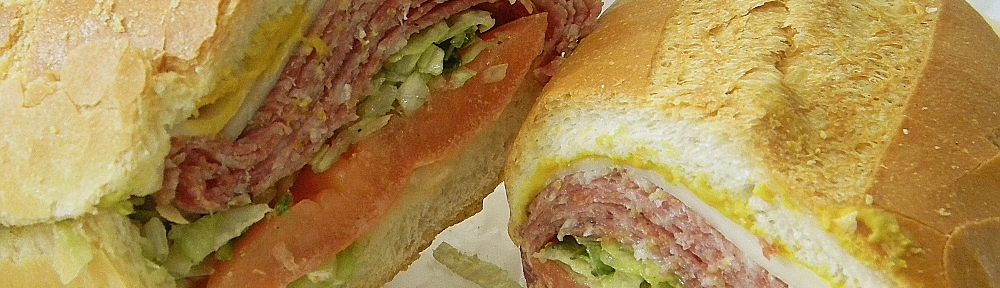
Long Phung Sandwich & Food is square on the southeast side of San Jose, an area where if you pick a store at random you’re more likely to hear Vietnamese than not. These are the places one goes in search of a fine bánh mì, and it has been my experience that the people in these areas are all too happy to provide that fine sandwich. There are some perils to this, however, and the language barrier is one of them. In most establishments the various sandwiches on offer are clearly delineated in Vietnamese, but the English names are a little bit more hazy. My beloved thịt nướng is sometimes labeled as BBQ Pork, and sometimes as Grilled Pork. In the case of Long Phung, the sandwich was clearly marked as thịt nguội, but the only English description provided was “Pork.” I could inquire after more information, but often the language barrier comes up again. I ordered the pork and went on my way.

As it turns out, thịt nguội means cold cuts. I’m no great fan of cold cuts, and it was interesting to see how they translated to my favorite sandwich. The meat was flavorful and moist, some with the more tender texture of ham and some more firm, as you might see in a salami. As for what kind of bánh mì they made, it was about what you’d expect. The baguette and vegetables were passable but not the best I’ve ever had, and it didn’t seem to me that the meat really had the chewy tenderness I look for. I phrase that personally for a reason. This is a popular filling for a bánh mì. I’ll touch on this later this month, but the more bánh mìs I eat the more I come to accept that other people might value different things. In the final analysis, that’s about where this sandwich stacks up. It wasn’t bad, but it just wasn’t for me.

On Sandwiches Presents: A Month of Bánh Mì

When I first started writing about sandwiches, I had a handful of big ideas I wanted to talk about. I knew I had thoughts about cheese, about cold cuts, about balance, and other topics of major importance, and I wanted to share those thoughts. These large ideas were spaced out as the site developed, partly because of the sandwiches I was eating but partly because I was afraid that I was going to run out. Once I’d put forth those big ideas, what else was there to talk about? This is something that plagues any commentator, I suppose, or any creator of content. But my expectations proved to be unfounded; the more I’ve said about sandwiches, the more I’ve discovered there is to say.

What I have planned for the month of January, though, needles at the confidence that I have developed. I intend to spend the month of January talking about the bánh mì sandwich and only the  bánh mì sandwich Its specific examples, its larger concepts, the questions it raises, and the answers it inspires. What I am driving at above, though, is that I’m not sure how this is going to go. There are a lot of different bánh mì sandwiches, but they’re all built in essentially the same mold, and I’m not sure how long I can go before posts are entirely “This ham was not as good as other ham. This cucumber isn’t as good as another cucumber I once had.” That level of discourse may fly elsewhere, but we at On Sandwiches believe you deserve better than that. Compounding this issue is that I often lean towards ordering the bánh mì thịt nướng. It’s the best sandwich, and if I’m comparing one establishment to another it seems only fair to compare their respective takes on the same item. So expect to see thịt nướng featured more than a few times over the next month.

Enough with the hand wringing. A month of bánh mì starts tomorrow, challenges be damned. I’ll do my best to find the limits of discourse, and we’ll go there together.

From the Archives: A Fried Chicken Sandwich, Pickles, and a Carpenter’s Plane

In the last two weeks of the year, On Sandwiches will be featuring select posts from the archives that you may have missed. We hope that you can forgive us these reruns, as we are hard at work on new, ambitious projects. Today’s selection is a fried chicken sandwich from Flanagan’s Ale House in Louisville, Kentucky.

You can forgive someone who aims high and falls short. It is easy to imagine someone without the means to do their best. But to see someone with such means and opportunity aim so low is truly despicable. The margin between simply being the best of a bad lot and being legitimately good is not so wide, and it is a shame more large-scale establishments do not try harder at crossing.


Southern Fried Chicken Sandwich, Flanagan’s Ale House, Baxter Ave, Louisville, KY

From the Archives: Truffles, Tragedy, and a Sixty Dollar Hamburger

In the last two weeks of the year, On Sandwiches will be featuring select posts from the archives that you may have missed. We hope that you can forgive us these reruns, as we are hard at work on new, ambitious projects. Today’s selection is The Rossini, a Hamburger from Burger Bar at Mandalay Bay:

The opera composer used to tell people that he had only known two moments of true tragedy. The first, he said, was when his mother died. The second was when a truffle roasted chicken fell over the side of a boat, lost forever.

The Rossini, Burger Bar at Mandalay Bay, Las Vegas Blvd, Las Vegas, NV

From the Archives: Los Reyes, Hubris, and a Torta

In the last two weeks of the year, On Sandwiches will be featuring select posts from the archives that you may have missed. We hope that you can forgive us these reruns, as we are hard at work on new, ambitious projects. Today’s selection is a chopped beef torta from Los Reyes de la Torta:

 This was a restaurant founded by two or more individuals with such faith in the quality of their food that from day one they announced themselves as the reigning sandwich sovereigns of Phoenix. This is, to say the least, a bold claim.

Chopped Beef Torta, Los Reyes de la Torta, N 7th St, Phoenix, AZ

From the Archives: Stages Deli, a Turkey Club, America

In the last two weeks of the year, On Sandwiches will be featuring select posts from the archives that you may have missed. We hope that you can forgive us these reruns, as we are hard at work on new, ambitious projects. Today’s selection is a Turkey Club from Stages Deli in New York City:

Almost as tall as the water glass there has to be four solid portions of turkey, more than a half dozen slices of bacon, 3 or 4 slices of tomato, and a fair amount of iceberg lettuce. The toothpick you can barely see is buried to the hilt and still did not touch the bottom third of this sandwich. I thought I understood the motivation. This had to be a sandwich made by someone who believes in Sandwiches, believes in America, believes in God, and moreover that God loves America, that God loves sandwiches, that he would bless such a towering effort.

Turkey Club, Stages Deli, 7th Ave, New York, NY

Guest Post – Sarah Sprague on a Tomato and Mozzarella Sandwich

From time to time esteemed members of the larger community of sandwich enthusiasts have a tale or idea too good to be kept to themselves or only shared privately. In these instances, On Sandwiches is happy to feature these contributions. In this case, Sarah Sprague brings a story about weary eyes and the saving grace of sandwiches.

By the time we reached Italian coast I hadn’t eaten a sandwich in nearly two weeks. I had seen beautiful over-stuffed sandwiches in the food halls of Harrod’s back in London, packaged sandwiches on the Eurostar as we sped through France, sandwiches with rich cheeses in Brussels, sausages with dark bread in Prague, ham with mustard in Switzerland and Austria, and all matter of stunning looking sandwiches at the gas stations along the German Autobahn; the latter being most curious to me, as it was nothing more than a market at a rest stop and yet there were these buffets of fresh sandwiches on display, allowed to breathe the fresh air and not wrapped in suffocating cellophane like I was used to seeing back in the States. They were the most appealing looking sandwiches I had ever seen in my life.

We were about thirty minutes away from our destination when we stopped for fuel at a roadside station in Italy. In the shop they were making all sorts of sandwiches for the truckers, each one made to order. We had left Luzern very early — my associate and I had actually stayed up all night watching the final night of the MLB regular season as it went down the wire — with nothing more than a cappuccino and the Tolberone mousses we had indulged in for breakfast filling our stomachs. Upon seeing the sandwiches in the Italian rest stop, I knew I needed to take a stand for our lunch and my sanity.

Traveling with other associates can be difficult. No one wants to impede on their companions’ usual routine. Traveling with your associate-in-laws can be even more difficult. No one wants to offend anyone, nor do they want to disturb any sort of trying familial dynamic. When my associate and I travel, we believe in big breakfasts, a snack — often a shared sandwich, and then a light dinner. This trip had been one large sit-down meal after another and both my associate and I were reaching our breaking point. As we walked back to the car after peeking in the shop, we agreed; we needed a sandwich for lunch. We knew were not going to be able to eat at the rest stop, but maybe once we got into town, we would be able to suggest we take it easy for our next meal.

It was unusually warm fall day, better suited for the busy August vacation month which made our little empty beach side hotel seem like a steal. Their restaurant was closed until evening, but the beach stand was open. A break. Everyone was tired and needed to refuel, the idea of roaming around was unappealing to the associate in-laws. Another break. The beach stand served fresh sandwiches. I could have hugged the woman at the front desk.

By the time my associate and I had put away our bags and changed into lighter clothing, the associate-in-laws had already found the snack stand and were halfway through their lunch. I saw prosciutto and I saw bread on their plates. I couldn’t wait to stare at the menu board for myself.

Tomato and mozzarella sandwiches may be one of my favorite sandwiches. Sometimes with pesto, sometimes with olive oil, basil, no basil, cracked pepper, no pepper. They are simple and comforting while being very dynamic on the palate; they are filling without weighing you down. Of course that was what I was going to order and share with my associate. A sandwich to calm both our nerves and our stomachs.

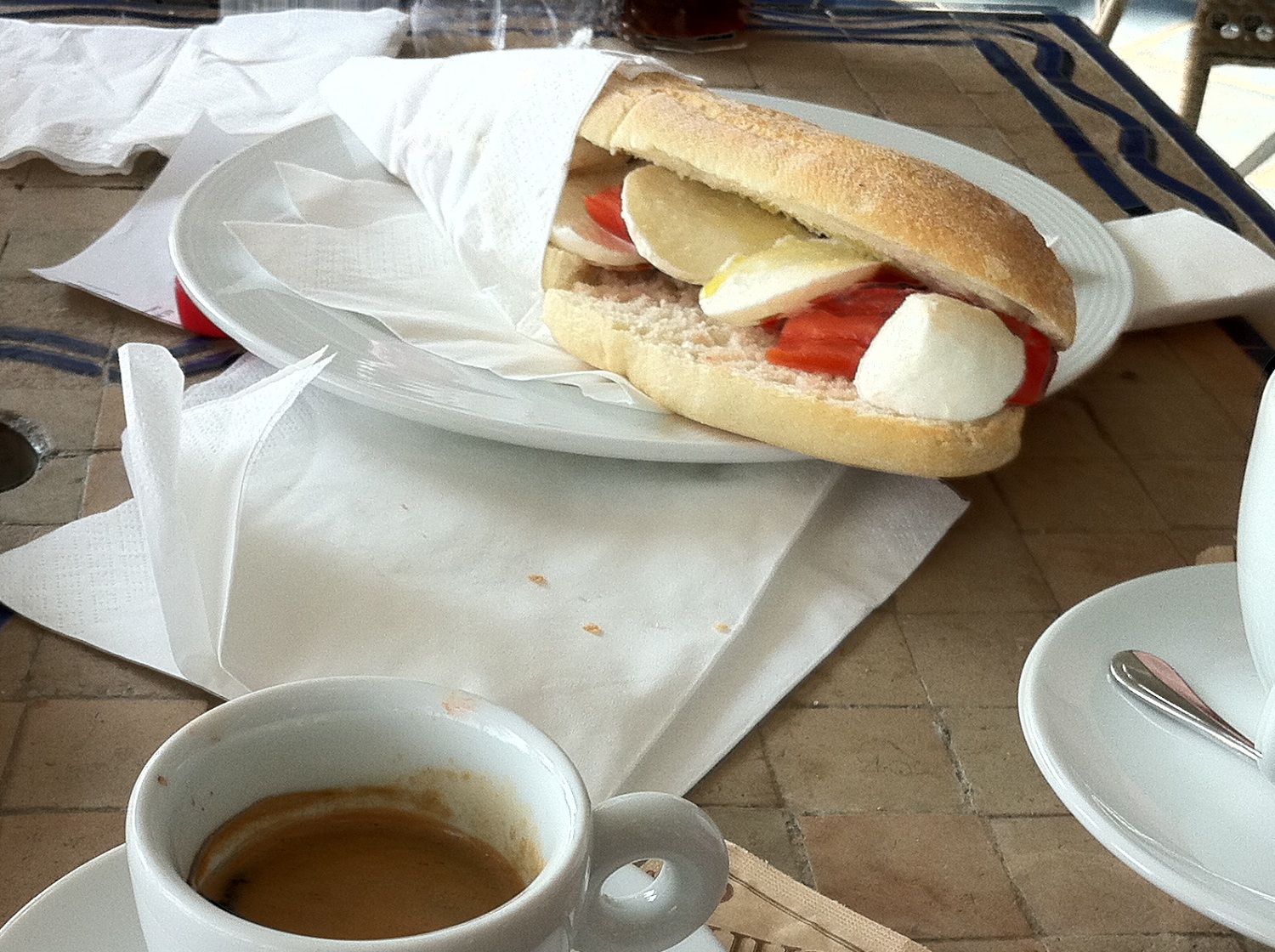
This tomato and mozzarella sandwich came with just a light drizzle of olive oil and was served on one of the most satisfying breads I have ever encountered. A flaky crust gave way to a chewy middle layer with a soft center. The tomatoes ripe and flavorful, juicy without being watery and tasted tart and sweet. Mozzarella was creamy with just a hint of salt. The olive oil gentle rolled between bread, cheese and tomato on each bite, its nutty richness working as the bass line to the other ingredients’ higher notes. While I ate my half of the sandwich, I wanted nothing more than skip the rest of the trip and stay at the little beach hut for the remainder of vacation.

We got back to Los Angeles about a week later. It was still warm, but I knew my days of seasonal heirloom tomatoes were numbered, even here in California. I wanted to recreate the magic of the day on the Mediterranean, but if I waited too long it was going to gone. I bought bread from one of the city’s finest bakeries. I went to two cheese shops before I felt I had suitable mozzarella. I found the nicest smelling tomatoes. I pulled out my finest olive oil and I made us sandwiches. They weren’t nearly as good as the beach stand sandwich, nor have any other tomato and mozzarella sandwiches been since our trip.