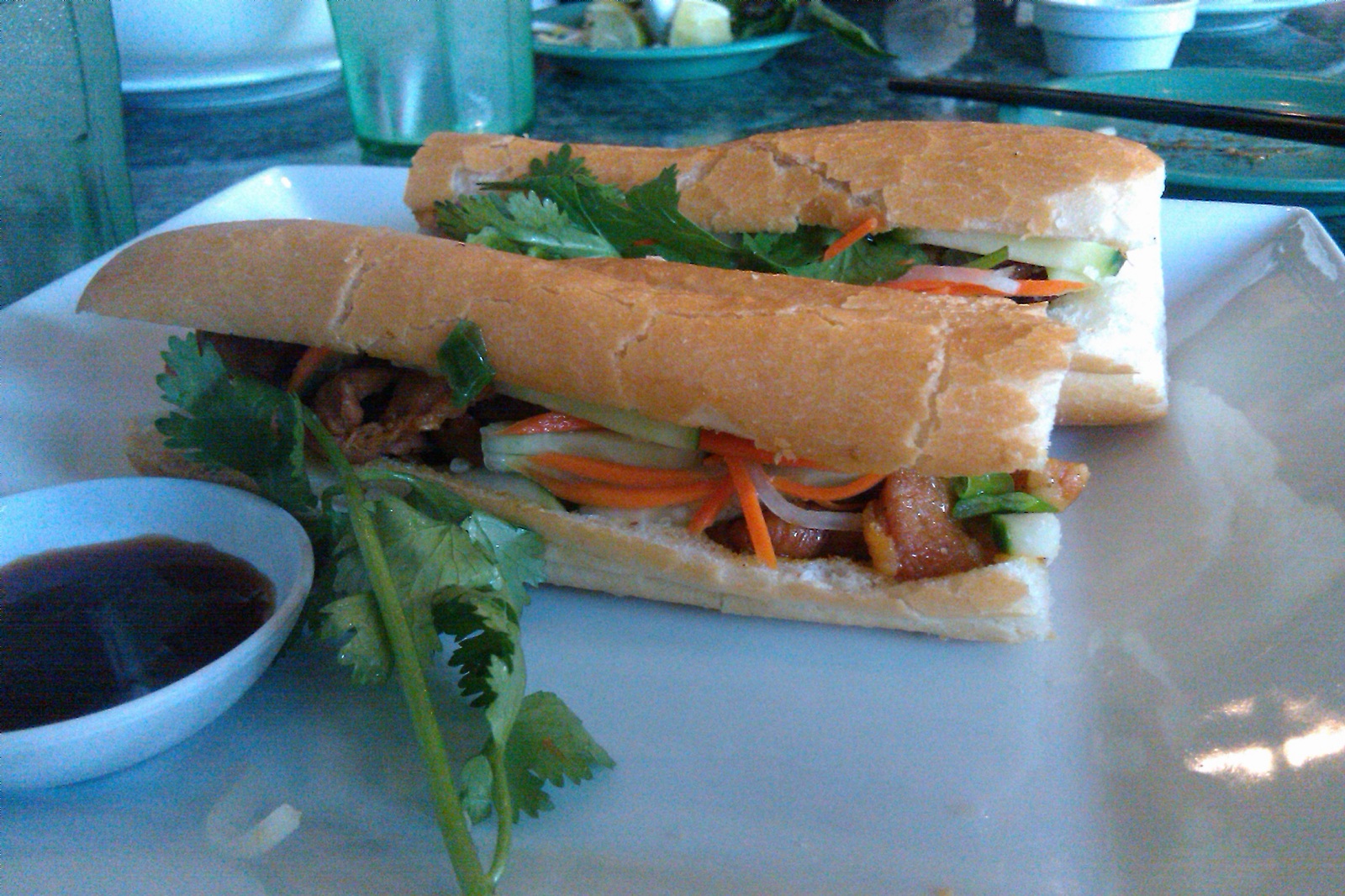
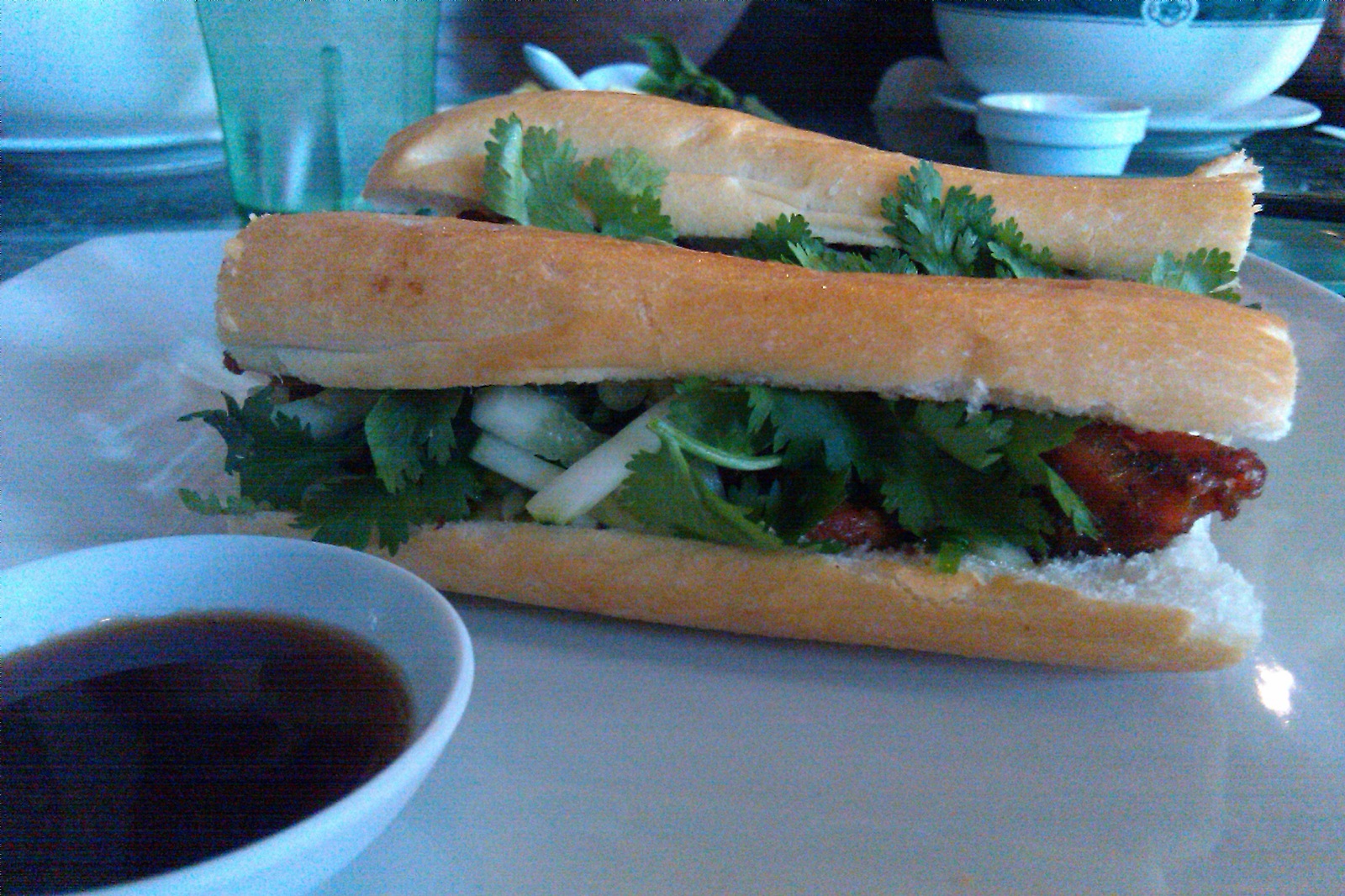
Thịt Nướng & Gâ Châ Bóng – Dakao, E San Salvador St, San Jose, CA

Having reached the middle stretch of a month of bánh mì, I find myself presenting sandwiches about which I do not have a tremendous amount to say. In other contexts I might simply elect to not say anything, as it is never my intention to bore readers or to waste their time. But Dakao is one of the few bánh mì options in downtown San Jose, so it probably justifies a few words. Thankfully, given that it is one of the only available options, Dakao makes a decent sandwich. It’s nothing spectacular, another establishment coasting on the high floor of the bánh mì, but it’s good enough. The pork was tasty but a bit sparse, leaving a sandwich where some bites were all flavorful pork and some were mostly Vietnamese mayonnaise.

The main fault with the shredded chicken lay with its lack of flavor, as it comes in a bit bland. All things considered, especially that you can get a sandwich for less than three dollars, the sandwiches are good enough, and some days that’s all you get.

Barbecued Chicken Sandwich & Charbroiled Pork Sandwich – Lemongrass Vietnamese Restaurant, Colorado Blvd, Los Angeles, CA

Yesterday I spoke of the bánh mì’s high-floor/high-ceiling, an idea that the average bánh mì is very good, and the best bánh mì almost incomprehensibly so. I also mentioned yesterday that bad bánh mìs, while rare, do exist. This, friends, is them. Lemongrass earns the sad distinction of being the first establishment in which I would, upon being questioned about the bánh mì, tell someone to skip it. It’s a restaurant with a full menu, and the four sandwiches on offer are but a small part of that menu. Being a sit-down establishment, the sandwich runs a bit expensive at $6. To be frank, they shouldn’t have bothered.

The sandwiches just feel limp. The vegetables are scarce, the buttery Vietnamese mayo lacking, the bread nothing notable, the flavors of everything else underwhelming. I hesitated writing this post. Truthfully, I ate these sandwiches some time ago and thinking back on them I think  that they couldn’t have been that bad. After all, high-floor/high-celing, right? The bánh mì itself is so good that any particular bánh mì can’t be terrible. And they weren’t terrible. But it takes a spectacular combination of apathy, bad luck, and willfully sub-par execution to produce a bánh mì better off skipped. I can’t truthfully say I regret eating these sandwiches, but until today I haven’t written about a bánh mì that wasn’t at least worth a stop, provided you were in the neighborhood. There are better sandwich options in Eagle Rock; save the bánh mì for another day, another establishment.

Chinese BBQ Pork & Shredded Pork – King Egg Roll, Story Rd, San Jose, CA

I spoke a bit about authenticity and neighborhoods here, and more recently I was grousing about a bánh mì I felt was overpriced. What today’s post goes to show, though, is that neither location nor price are legitimate markers of quality. They may be clues, but in the end only in trying the sandwich can one find its true measure. King Egg Roll is on the Vietnamese side of San Jose, and the sandwiches are a steal at $2.50 each. The problem, though, is that they just aren’t that good.

The bánh mì is somewhat unique in that as a concept it possesses both a very high ceiling and a fairly high floor; there exist truly bad bánh mìs, but they’re somewhat rare. The sandwiches at King Egg Roll aren’t bad, they just aren’t good. As you might surmise from the name, sandwiches aren’t the main attraction at King Egg Roll. Fried rolls and shrimp balls get top billing, and sandwiches appear to be an afterthought. Perhaps someone took the high floor concept for granted, and figured any old sandwich they slapped together would excel. That wasn’t the case, but it’s a testament to the sandwich (as a concept, not in this example) that I still left King Egg Roll satisfied. The BBQ pork was a bit dry, and the shredded chicken not particularly flavorful, but a bit of chili sauce gave both some extra kick. Altogether, it’s just tough to go wrong. For $2.50 you get a balanced sandwich on a crusty roll. There isn’t much room in there for complaint.

Banh Mi Thit Kho – Cô Ba, 9th Ave, New York, NY

The pork belly bánh mì at Cô Ba sells for $8, which made it the most expensive bánh mì I’d ever seen. In truth were I only pursuing sandwiches for my personal pleasure I’d scoff at such a thing and head over to Chinatown, where a sandwich almost certainly just as good can be had for nearly half the price. But I am in this not just for myself but for a community of enthusiasts, so I swallowed my objections and ordered the sandwich. Besides, perhaps it would be the best bánh mì I’d ever had, a sandwich that would change my life. In that case it might very well be worth the $8! Well, cutting to the chase, it wasn’t worth it. Were I not so accustomed to paying between $4 and $5 for a sandwich I might have no objection at all, but I am and so I do. It was a good sandwich, but no $8.

I would like to make clear, though, it was a good sandwich. Most everything was in the “pretty good” range, better than acceptable but not so good as to be great. The meat was the real highlight, a rich, fatty bit of pork belly. It’s a shame that the jalapeños you see pictured there are the only ones involved. Jalapeños fit better on this bánh mì than any I’ve ever had, the heat cutting the fat nicely. There was a lot more cilantro than average as well, but the pork belly stood up to that just as well as it did the chilies. In the end, it might not be fair to define a sandwich entirely by its price, but nothing exists in a vacuum. Pork belly isn’t something usually offered on a bánh mì, but all sandwiches exist in a larger context and when a short walk will net you a few bucks saved and a better sandwich, it’s hard to get too excited, pork belly or no.

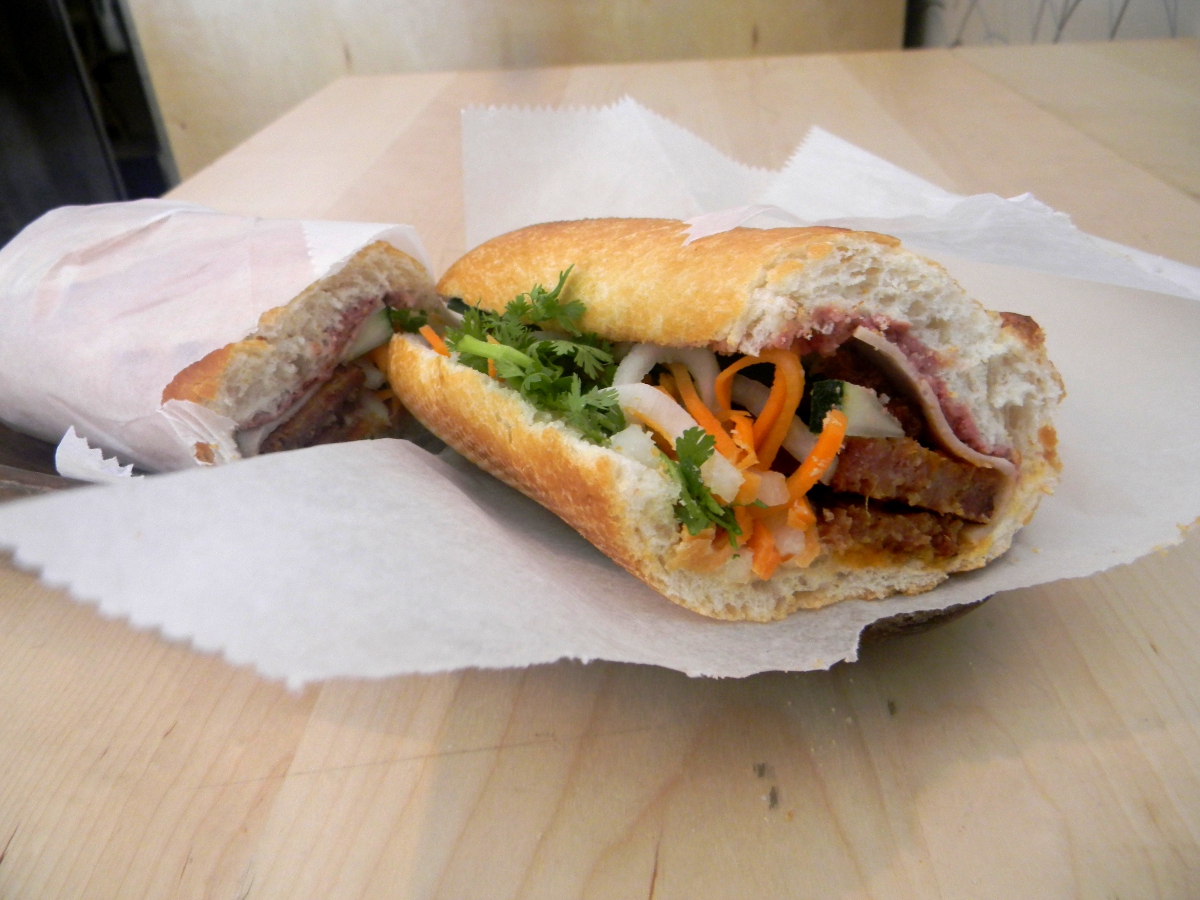
Grilled Pork Patties – Bánh Mì Zớn, E 6th St, New York, NY

There is a reason this sandwich is named in English. Bánh Mì Zòn is highly regarded by New York fans of the bánh mì, and when I was in town I was excited to see what the fuss was. Looking up the address, I was a little bit surprised to find that it was in the East Village. People have called Bánh Mì Zòn home to the best bánh mì in New York City (something with which I would obviously take issue.) Zòn was going to be only the second bánh mì shop I had been to that wasn’t located in a heavily ethnic area. Going in, I was skeptical. Arriving at the shop, my concerns only grew. The shop is new, with tables and stools in an unblemished, unfinished wood. It was…clean. Most bánh mì shops I’ve been to aren’t dirty, exactly. Cluttered might be a better word for it. There’s frequently racks or shelves piled with Vietnamese packaged foods, the signs are often handwritten or printed on 8.5×11″ paper. In general there’s a slipshod quality to them. Bánh Mì Zòn was having none of that, and that’s why the title of this post is in English. This was the first place I’d been to where English seemed to come first.

I don’t have a fetish for authenticity. I’m not going to claim that a good bánh mì can’t be found in non-ethnic neighborhoods. I’m not going to insist you need dust on top of the refrigerator case and an oven missing a dial to make a proper sandwich, and I’m not going to say that anyone who wasn’t enjoying one years ago can’t enjoy one next year. The whole thing just gave me cause to think. I found myself considering the future of the bánh mì. It’s a good sandwich, in the collective sense. That’s no secret, but you run across more people who haven’t had one than people who have, and it’s too good to stay that way. I’m going to bring this up again later this month, but the future of the bánh mì involves significantly more widespread availability. It involves evolution, offshoots and different takes. It involves franchises. I’ve been singing the virtues of the bánh mì to anyone who would listen for a while now, and I’ve been able to do that because I feel like I understand the sandwich. When I recommend that someone try one, I have a certain confidence in what they’re getting. The idea of a future where that isn’t true frightens me.

In a lot of ways this is no different than any other outgrowth of culture. We all come from somewhere, and our people all make something special. Eventually, if we want to share that thing with the world at large, we have to accept that it isn’t always going to be what it was when we first came to love it. I feel a bit ridiculous saying all of this. Obviously I have no personal grounds on which to contest the evolution of the bánh mì — I am only sharing what someone else was kind enough to share with me. But the idea that the thing that I love may someday be completely different is scary. And when I walk into a banh mi shop that looks nothing like virtually every other bánh mì shop I’ve ever been to, it’s hard not to let the mind wander to unsettling places.

After all of that, my fears remain in a hypothetical future. Bánh Mì Zòn makes a good sandwich, particularly a very good baguette. I don’t think it’s the best in New York City, but I’m not making a straight comparison. The #1 at Zòn is pate, terrine, ham and pork floss. I wanted a more A-to-A comparison, so I got the grilled pork patties, the closest thing to my beloved thịt nướng, frequently referred to as “grilled pork.” Even that turned out to be an unfair comparison, I think. I much prefer the marinated and caramelized bits in thịt nướng, but nem nướng is a different product. It was flavorful and moist, but as I ate it I kept looking at it and thinking of how much surface area had gone ungrilled, how much unfulfilled potential there was for chewy texture and deep flavor. But all in all it’s still a very good sandwich, if you can handle clean floors and new tables.
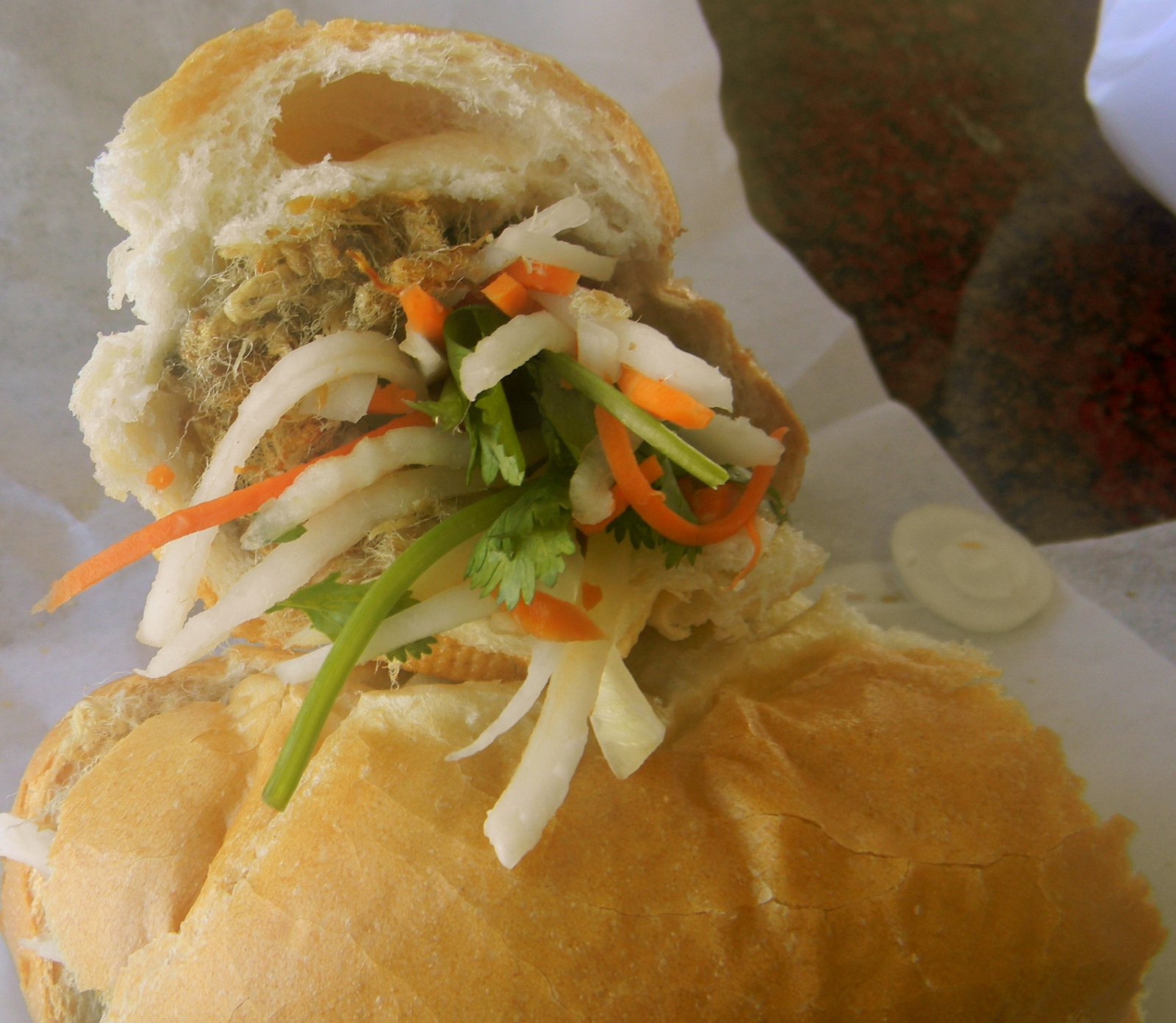
Bánh Mì Bì – Thanh Huong Sandwich, Senter Rd, San Jose, CA

Bì is dry, shredded pork skin. I don’t recall exactly what the menu board at Thanh Huong said, but I am certain it did not include skin. I believe “Roast Pork” was the title. What I found when I sat down to eat my sandwich was not what I was expecting, but what would the world of sandwiches be without surprises? This was my first encounter with bì, but I was excited to try it. Sadly, my excitement was short lived. I found it to be too dry and too salty, and though I understand those are something like features when it comes to bì, this just seemed excessive. That might be my palate; I’ve come to love flavors from all over the world, but I was raised on distinctly American fare. The texture was interesting, and not in an objectionable way. It’s meat floss, and it has a wispy, fine texture worthy of that name. What seems like innumerable strands come together for a dense, very chewy bite. It’s a product that shows up in a number of Asian cuisines, and I would certainly give it another shot. I’d like to try it outside of a sandwich just so I can get a better sense of how things line up. That’s something I think we take for granted when evaluating the sandwich as a whole. We are generally familiar with our ingredients, and knowing what they taste like independently gives us a better sense of how they relate to each other. Operating in unfamiliar territory, that sense can fade quickly. So perhaps the failure here is mine, perhaps it’s the sandwich maker’s. In the end, the only thing of which I can be certain is what was right there in front of me, and that was a disappointing sandwich.

Bánh Mì Thịt Nguội – Long Phung Sandwich & Food, Tully Rd, San Jose, CA

Long Phung Sandwich & Food is square on the southeast side of San Jose, an area where if you pick a store at random you’re more likely to hear Vietnamese than not. These are the places one goes in search of a fine bánh mì, and it has been my experience that the people in these areas are all too happy to provide that fine sandwich. There are some perils to this, however, and the language barrier is one of them. In most establishments the various sandwiches on offer are clearly delineated in Vietnamese, but the English names are a little bit more hazy. My beloved thịt nướng is sometimes labeled as BBQ Pork, and sometimes as Grilled Pork. In the case of Long Phung, the sandwich was clearly marked as thịt nguội, but the only English description provided was “Pork.” I could inquire after more information, but often the language barrier comes up again. I ordered the pork and went on my way.

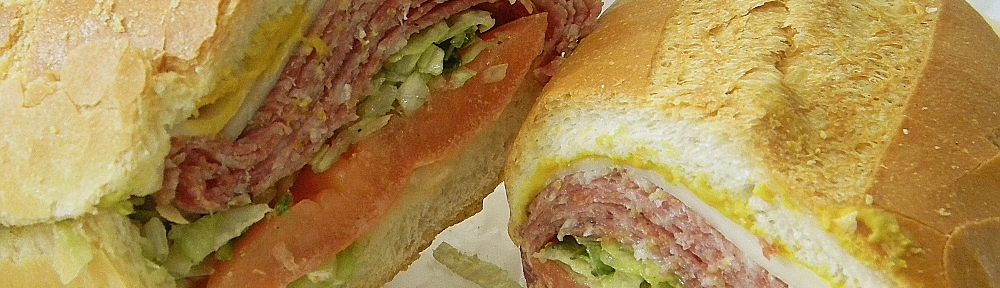
As it turns out, thịt nguội means cold cuts. I’m no great fan of cold cuts, and it was interesting to see how they translated to my favorite sandwich. The meat was flavorful and moist, some with the more tender texture of ham and some more firm, as you might see in a salami. As for what kind of bánh mì they made, it was about what you’d expect. The baguette and vegetables were passable but not the best I’ve ever had, and it didn’t seem to me that the meat really had the chewy tenderness I look for. I phrase that personally for a reason. This is a popular filling for a bánh mì. I’ll touch on this later this month, but the more bánh mìs I eat the more I come to accept that other people might value different things. In the final analysis, that’s about where this sandwich stacks up. It wasn’t bad, but it just wasn’t for me.

Revisited: Poor House Bistro, San Jose, CA

San Jose’s Poor House Bistro was previously featured here, and today’s post doesn’t have a lot to add beyond the description of two more sandwiches. Not all sandwiches need be philosophical questions, I suppose. The sandwich featured above is the BBQ Shrimp Po’ Boy, which is billed as New Orleans sauteed shrimp in a “spicy” and tangy sauce. I’m not sure why “spicy” is in quotes, but sometimes descriptions of sandwiches can be a bit screwy. In this case, what the description really needed was “peppery,” as that’s the best way to describe the sauce. I prefer my BBQ smokey and a little bit sweet, with the heat playing in the background. That’s not what I found in this sandwich, as vinegar and hot pepper took the foreground. Some folks may find this to be exactly what they’re looking for, but it just wasn’t for me.

The Cochon de Lait Po’ Boy, on the other hand, is much more my speed. A pile of slow roasted pork with the standard cabbage, tomatoes, and pickles, this was delicious. It was also deceptively filling — that pork may not travel to the outer edges of the sandwich but there’s plenty of it. It’s rich and it’s juicy and by the last few bites of this sandwich I found myself more than sated. The cabbage provided a pleasing bit of crunch to counter things, and nothing in the sandwich provided a strong enough flavor to outweigh the pork, which had a decent portion of garlic to the flavor. All in all, this was a well balanced, delightfully savory sandwich, and anyone craving a po’ boy in the bay area could do a whole lot worse than this one.

Jerk Chicken – Four Cafe – Colorado Blvd, Los Angeles, CA


A jerk chicken sandwich was one of the first sandwiches featured here at On Sandwiches, and in that post I stressed authenticity. This sandwich was good but clearly inauthentic, and what I mean by that is that the chicken wasn’t rubbed and smoked. It was spiced and grilled, and served with a smoky “jerk sauce” that attempted to bridge the resulting gap in flavor. It was a good sandwich, and the jerk sauce was really good (for jerk sauce.) But it left me with some larger questions.

How big is the world of sandwiches? Is there room enough for a sandwich that could be better and a sandwich that is better, both of them aiming for the same thing? Is it possible for one person, your humble enthusiast for example, to genuinely appreciate both sandwiches without being at least a little disingenuous on either end? Is there any value in “good, not great”? There is an argument for judging each sandwich on its own merits, but that has always seemed to me to be impossible. Where does a sandwich stand except among its contemporaries? How can I rank it but among what I have already known?

Here is my dilemma: I want to tell you this was a good sandwich. But in the past I have railed against those sandwich makers that I perceive as lacking in effort, and it seems inconsistent (to say the least) to say, of this particular sandwich but not of several others, “could have been better, but pretty good.” The challenge left to me is to carve out some ground to stand on, and I think I’m up for it. It comes down to reasonable expectations and degree of difficulty. Four Cafe is located along a major throughway, in a string of connected buildings, and they serve a variety of food. It isn’t reasonable to expect them to have a smoker for a single sandwich. It wouldn’t be impossible, and it would be spectacular if they did, but it’s hard to get too worked up when they don’t. Contrast something like that with an establishment using a processed avocado paste. Using fresh avocados is no Hurculean task, and so forgiveness for not doing so should be hard to come by.

I can’t help but feel as if I am not approaching a particularly satisfying conclusion. I’ve avoided this topic for a while now, preferring just not to write about some sandwiches, rather than clog things up with endless “good, but not great.” But this was a good sandwich, and in the end, maybe good is good enough. I suppose I just have to ask you to trust me. Should you be in the neighborhood, Four Cafe is worth your time. The food is fresh, and it really is a good jerk sauce. There’s room in the world of sandwiches for the three-stars-out-of-five review. When unspectacular is still satisfactory, I’ll let you know. And when a middling effort produces damnable results, you’ll hear about that too.

Crab Cake Sandwich – Dogfish Head Ale House, West Diamond Ave, Gaithersburg, MD

image

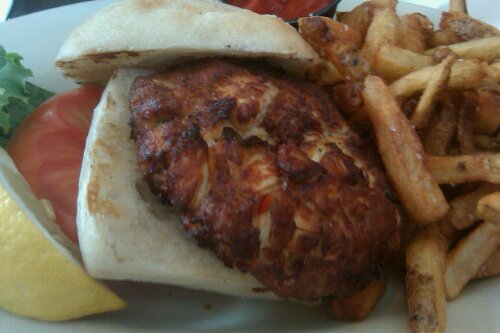
As the name leads you to believe, Dogfish Head Ale House is a brewpub centered around the Dogfish Head brand of beers. I enjoy libations and spirits as much as the next person, but as always my primary concern is the sandwiches. One might expect that any establishment that attempted both fine beer and fine food would fall short in at least one of those categories, likely the food. My experience, happily, has been quite the opposite. Cambridge Brewing Company in Massachusetts and Stout in New York City have always treated me well. So how did this Ale House stack up against some of my old favorites? Well, this wasn’t a bad sandwich, but you can see for yourself there just wasn’t much there. The crab cake was first rate, fresh tender crab and plenty of it. Beyond that, there wasn’t much going on. There was a leaf of lettuce and a slice of tomato on the plate, something which I find to be a bit of an annoyance.

An associate recently asked me why it was that I preferred to order a sandwich as-is, asking for no modifications and often not asking in advance whether a sandwich will come one way or the other. My answer was that I wanted to see the sandwich someone else is capable of, not the sandwich they’re capable of being coached to make. Standing behind a sneeze guard and hollering instructions to some poor sap in crinkling plastic gloves and a greasy visor is not my idea of a good time. You make the decisions, I say, I’m here for the results. So getting a plate that features an unadorned patty, lonesome on a bun, lettuce and tomato adjacent, well that just browns my avocado, so to speak. If you think the sandwich needs them, add them. If not, don’t. You handed me a menu when I walked in, not a ballot. I digress.

The sandwich did come with a house made tarter sauce that was quite good, and together with the quality crab this was a more than servicable sandwich. I’ve had some pretty fine crab cake sandwiches, so in eating this one I was a bit lost, thinking of onions, or roasted red peppers, or lightly dressed slaw, or pickled jimica, or thin spices of cucumber dressed in a spicy mustard, or anything else you might add to a crab cake sandwich to make it special. With those in mind, it was hard to get excited about this sandwich. It wasn’t bad, but it’s hard to love something that announces itself as an echo.