Pan con Chicharron – Sanguchon, San Francisco Bay Area

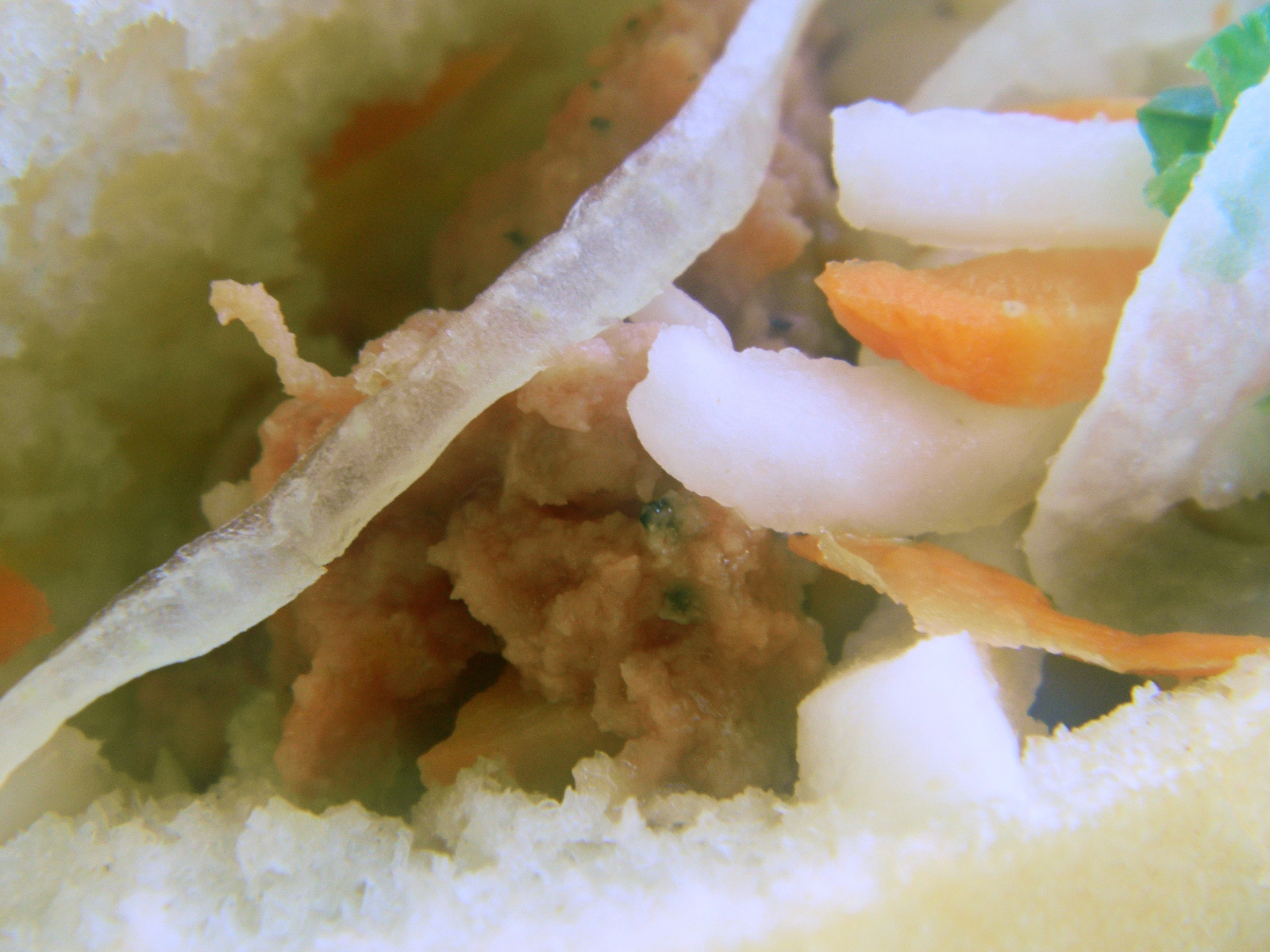
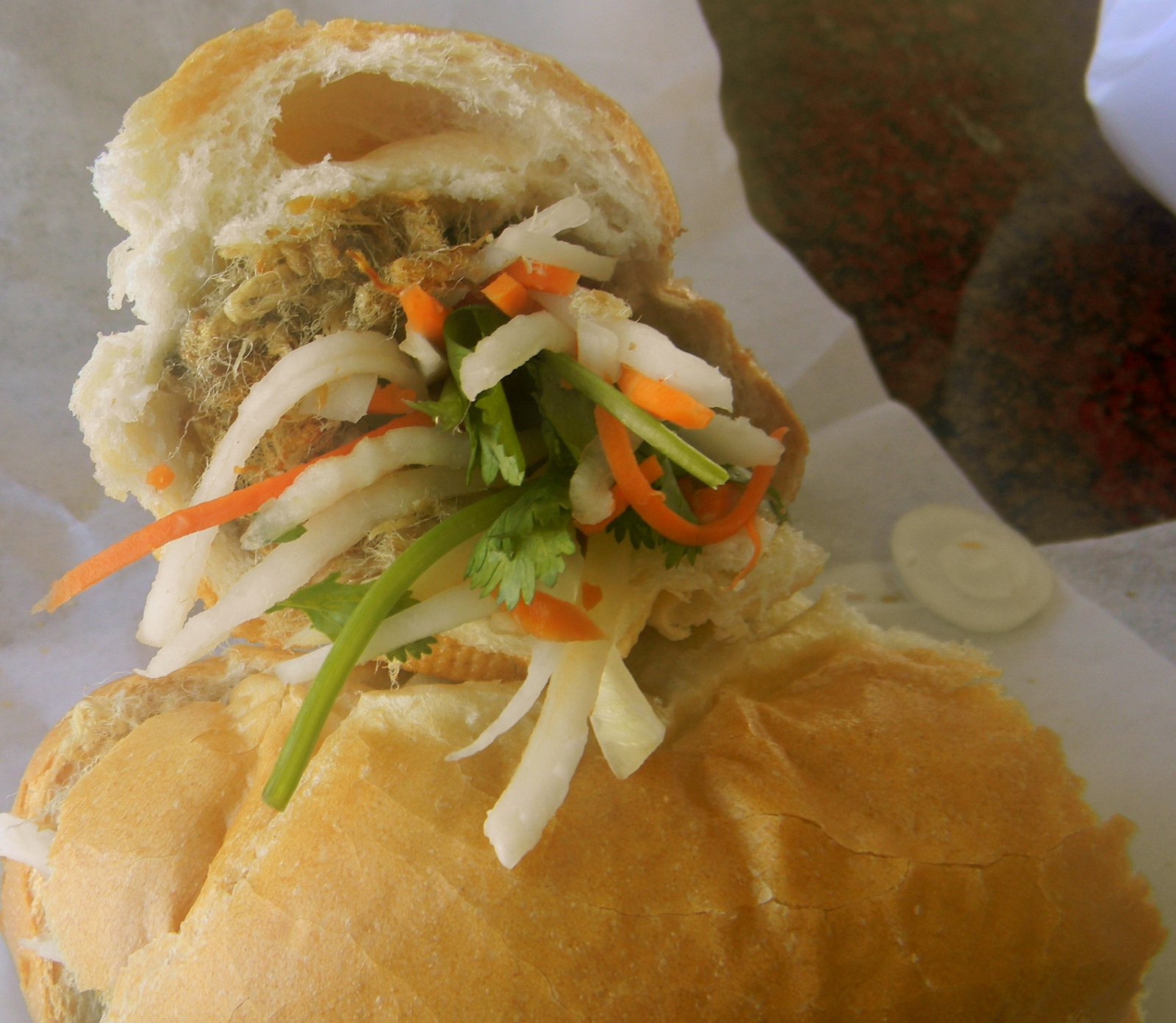
Sanguchon is a Bay Area food truck providing Peruvian street food, and I was excited to try their wares. At a glance, the Pan con Chicharron seems like an extraordinarily appetizing sandwich. Sliced pork loin joins fried yams, salsa criolla and aji rocoto aioli on a roll baked (they say) exclusively for their truck. Those aren’t ingredients you see every day, and though I enjoy a good torta, too much of anything gets old. Salsa criolla is a salsa with a red onion and cilantro base, and aji ricoto is a chili pepper with more heat than a poblano but not as much as hot jalapeño. So you’ve got savory pork,  a crispy sweetness in the yams, a sharp salsa corralling things a little heat playing over everything. That’s a potentially great sandwich, and I strongly suspect that there are days when the sandwich Sanguchon serves lives up to that potential. Sadly, the day that I got my hands on it it failed to meet its mark. I will say that the bread was very good, chewy and with a flavorful crust. There was no disappointment there. I have neither a strong affinity for nor a strong grudge against food trucks,  but I can’t help but wonder if the fact that this sandwich came from a truck had a lot to do with inconsistency. There’s an urgency in serving food from a truck, especially when it’s busy (and it was busy.) People stand around waiting, it doesn’t lend itself to conversation or nursing a drink, and so you want to get them their food as fast as possible. Sometimes that means the food comes out terribly unbalanced, with large, meaty pieces of pork crying out for salsa and aioli, yams delightful when present but unaccounted for in far too many bites. Had someone taken a bit more time putting the sandwich together I suspect it would have been a very different result. Alas, one cannot dine on possibility. It is reality we dig in to, and the reality at Sanguchon was a disappointing sandwich.

Kotlet Sandwich – Bijan Bakery & Cafe, Market St, San Jose, CA

I believe that almost anything can be effectively incorporated into a sandwich, given the right plan and proper execution. There aren’t many things at which I’ll turn my nose up on sight. That said, I often despair at the sight of iceberg lettuce. Don’t get me wrong; like anything else, it has its place. It’s got a lot of water to it, and it it’s pretty crispy, so it works well in spicy situations, or playing against softer ingredients. More often than not, though, it’s not deployed in those situations but instead is just the thoughtless lettuce of the lazy, an unthinking default offering, adding nothing to the sandwich. Combine it with the sight of a mushy slice of hothouse tomato and before your first bite you know that this is a sandwich where nobody was trying very hard. That’s always disappointing, but it’s exceptionally so when other ingredients are above par. The bread at Bijan Bakery was stupendous, a flavorful sourdough with a really substantial crust. The kotlet, a patty of ground meat with a strong dose of turmeric, was also pretty tasty. There was a bit of always-tasty whole grain mustard involved as well, leaving the sandwich a puzzling bundle of contrasting elements. Could this sandwich have been the product of some committee, half its members putting in care and experience, the other half slacking off? Was it assembled by survey, or by mishmash of remaining parts? Perhaps someone died in front of a half-created sandwich, and some uncaring distant relative wrapped things up without a thought for the legacy! I’m sure the real story is much more mundane, but whatever that story is, what sat in front of me was inescapable fact: I had been served a sub-par sandwich.

Croissant Sandwiches – Le Boulanger & Manley’s Donuts, San Jose, CA

Scrambled eggs, chopped bacon, and cheddar cheese on a croissant. It’s simple, and it would be far too easy to simply inhale one early in the morning and never think twice about it. There’s a lot going on there, though. A tender, flaky croissant. Fluffy eggs. Crispy bacon.  Cheese. The risk of this negligence of attention seems highest at breakfast, I think. The breakfast sandwich is one that is rarely a respite from something else; when one sits down for lunch or supper one is often trying to unwind, taking a short solace in simple pleasures. At breakfast your’re gearing up, considering the day that lies ahead, and as a result your sandwich may get scant attention. In this case, I was at the airport, taking in an early sandwich before I started an extended vacation. I can’t honestly tell you that I gave this sandwich what it was due.

That sort of mindless eating is unfortunate, but the alternative can be even worse. Such was the case with the similar sandwich I got from Manley’s Donuts, also scrambled eggs and bacon on a croissant. My mind may have started to drift, but this sandwich wasn’t having it. The labor required to dispatch tough, chewy bacon functioned as a sort of preliminary roadblock, and the dense, greasy croissant only slowed things further. This compounds the earlier sin, I suppose. The good sandwiches run the risk of passing hardly noticed, but the bad ones refuse to be ignored. In both cases, a sort of lack of effort undermines the whole thing; either you drift away or else you are put upon. I put it to you that true enthusiasm, sandwich or otherwise, requires effort. It requires a certain focus. Don’t we owe that to ourselves? Don’t we owe that to our sandwiches? In instances such as the sandwich from Le Boulanger, such effort pays off in the experience of a very good sandwich. In instances such as Manley’s Donuts, well…take it as a learning experience. The next time I approach the heights of some fine sandwich, I’ll take a brief moment to remember the greasy depths of Manley’s Donuts. There’s no reason to seek out bad sandwiches, but there’s also no reason to let one go to waste.

Grilled Pork & Pork Meatball – Lee’s Sandwiches, E Santa Clara St, San Jose, CA

In my review of Bánh Mì Zớn, I spoke briefly about the future of the bánh mì. “It involves significantly more widespread availability,” I posited. “It involves evolution, offshoots and different takes. It involves franchises.” Lee’s is that future. With at least 41 domestic locations stretching from California to Oklahoma and a handful of international locations, Lee’s 20 years of existence have been fruitful, seeing the kind of rapid spread one might expect from the purveyors of fine sandwiches. The establishments seem built for expansion; there are bright, English signs, most stores are spacious and clean, they offer traditional American sandwiches as well as the standard offering of Vietnamese.

I’m not inherently opposed to the idea of a franchise. They’re not my preferred place to get a sandwich, but I think they serve a purpose and, evaluated on their own terms, they have a decent amount of value. A Big Mac tastes like a Big Mac no matter where you get it, no matter how long it’s been since you last had one, it’s always exactly what it was, exactly what you would expect. I can understand why some people find this objectionable, but I can also see the perverse appeal in it. So there’s a logic and a role to the franchise, even if it isn’t the most noble role around. Think about it; associates have written me as this month has progressed, bemoaning the lack of bánh mì options in places like Fort Wayne, Indiana. So if we hope that there will come a day when people in mid-range and far-flung corners of this country can get their hands on a delicious baguette full of well seasoned meat and fresh vegetables when they want them, can we really turn our noses up if it takes a homogenized, repetitive establishment to achieve that? I would say not.

It is by these standards that Lee’s falls short, unfortunately. Lee’s started as a catering truck in San Jose, and I dearly wish I’d been able to sample the wares from that truck. That is a privilege that has thus far escaped me in life, to watch an establishment grow, changing over time, meeting advantages and disadvantages along the way. All I can do is examine the product as it stands today. And I would tell you how the product fares today, but tragically it all depends on from which Lee’s you order your sandwich. By design, the Lee’s franchises vary in three major ways. There are so-called production units, where baguettes are baked and ingredients prepared both for sandwiches sold on-site and to be distributed to other Lee’s in the surrounding area. There are non-production units, where these ingredients are received and then sent out again, and finally there are mall units, non-production units situated in food courts. As you might imagine, food quality is typically highest at a production unit, and it can vary considerably at other locations, based on their proximity to a production unit, their average sales volume, and who knows what else. So Lee’s falls short in what is perhaps the sole truly redeeming value of a franchise: consistency. Subway may charge you $5 for a big pile of salt, but it’s the same pile of salt every time. Even within a single Lee’s, the sandwiches vary considerably from day to day. The grilled pork sandwich pictured at the top of this page was flavorful and with a crispy baguette, a reasonably facsimile of a proper thịt nướng sandwich. But on other days the sandwiches have been dry, with tough baguettes and sparse filling. The second sandwich pictured is xíu mại, which had a texture not so much of broken up meatballs but just a mushy pile of meat, an extremely salty one at that.

Tragically, as the bánh mì makes its way in the larger world, the strongest wind in its sails is a sputtering one, one of inconsistent vision and execution. Maybe these are growing pains, and as Lee’s settles in things will start to smooth out. I suppose that’s a possibility, but that might be asking more patience than your average sandwich enthusiast can muster. I know that someday someone to whom I have extolled the virtues of the bành mì will try one and not be impressed. To my knowledge it has yet to happen, but it’s inevitable. While it would be disingenuous to deny the self-interest in that idea, it isn’t really about me. It’s about what I know about the bành mì, the heights I know a sandwich can reach, and my sincere desire that any and all interested persons experience those heights. Anyone who loves sandwiches deserves to have a really great bành mì. Lee’s works to put this farther out of reach, and for that I cannot forgive them.

Thịt Nướng & Gâ Châ Bóng – Dakao, E San Salvador St, San Jose, CA

Having reached the middle stretch of a month of bánh mì, I find myself presenting sandwiches about which I do not have a tremendous amount to say. In other contexts I might simply elect to not say anything, as it is never my intention to bore readers or to waste their time. But Dakao is one of the few bánh mì options in downtown San Jose, so it probably justifies a few words. Thankfully, given that it is one of the only available options, Dakao makes a decent sandwich. It’s nothing spectacular, another establishment coasting on the high floor of the bánh mì, but it’s good enough. The pork was tasty but a bit sparse, leaving a sandwich where some bites were all flavorful pork and some were mostly Vietnamese mayonnaise.

The main fault with the shredded chicken lay with its lack of flavor, as it comes in a bit bland. All things considered, especially that you can get a sandwich for less than three dollars, the sandwiches are good enough, and some days that’s all you get.

Vegetarian Bánh Mì – Hamilton’s Tavern, San Diego & Tofoo Com Chay, San Jose

The veggie grilled pork sandwich at Tofoo Com Chay in San Jose

I first ate this sandwich over two years ago, fairly soon after I decided to start a sandwich blog. It’s a fairly standard vegetarian bánh mì: fake pork, cucumber, carrot and plenty of cilantro on a crusty baguette. It’s a good sandwich, but I ate it very soon after one of my experiences with the best sandwich in the world, so I had a fresh memory of a really great (pork containing) bánh mì to compare to. I wasn’t quite sure what to think. Was it fair to compare the two sandwiches? What were their relative strengths? Was I even capable of objectively considering it in its own right? That was in December of 2008, and I’ve been ruminating on the answers to those questions ever since.
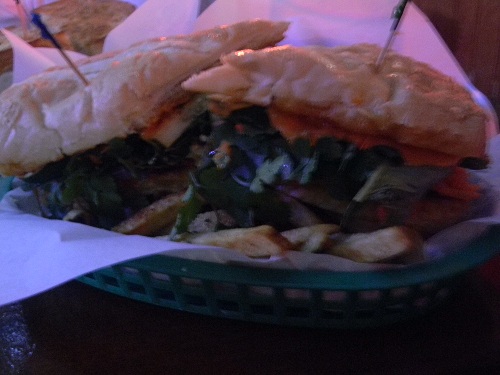
This is the “Banh From the Pubs,” from Hamilton’s Tavern in San Deigo.  Cucumbers, carrot and daikon slaw join red onion, basil, cilantro and a house made hotsauce. In contrast to most bánh mìs, the bread here was sliced all the way through and the ingredients piled high. Bánh mìs are a lot of things, but “stuffed” generally isn’t one of them. I ate this over ten months ago, and my thoughts on the original sandwich joined with thoughts from this one and began to crystallize. Finally, I know what I want to say.

I feel as if I am on shaky ground, making this declaration and making something I love so much off limits to so many people. But I’ve thought about this a lot and I feel like this is the right thing to say. I was a vegetarian for seven years. I have nothing but respect for people who make what is a legitimate ethical concern their foremost concern in what they eat. But if we sit down and plot where their world intersects with mine we cannot just place things wherever we like. We must place them where they belong.

Imagine listening to La Traviata, only one of the channels in your stereo has gone out. You are still hearing beautiful, wonderful music but it is incomplete, doomed. At the height of Act II each cry from Violetta would go unanswered, she would plead with no one, finally agreeing to sacrifice her greatest love, giving in to non-existent demands, an empty hissing sound. That isn’t art, it’s tragedy. Someone asked me about the sandwich from Tofoo Com Chay. “If I’d never had a regular bánh mì,” I said, “I’d think this was a really good sandwich.” But I have had one, and I cannot help but think that one without meat is irredeemably flawed.

It might seem silly, at first, to suggest that people who do not want to eat meat are missing out because they aren’t eating meat. But knowing this sandwich both with and without meat I cannot help but define those without by what they lack. Consider a person who drives a convertible, and more than that refuses to leave the house when it rains. The only decent thing to do is to respect their choice, but I have no obligation to think it complete. Moreover, I wouldn’t suggest they approximate the experience of sharing a kiss in the rain by necking under the shower head. The meat, the pâté, it’s all missing here, and it’s a striking absence. People who don’t eat meat make a choice, one I respect and understand. That choice includes giving certain things up, and I suggest that bánh mìs should be among them.

The two sandwiches make my point in different ways. The sandwich from Tofoo Com Chay presents a fake meat in place of pork, meaning it is aping the particular style of bánh mì that I love so much. This is directly what I am addressing above. The sandwich at Hamilton’s, meanwhile, forgoes any mimicry and just rachets up the heat. Making a sandwich more spicy can improve it, but it can’t save it. If this is what your sandwich needs to be interesting, good, or  seem worth what you charge for it, I suggest you have gone wrong at some early step and ought to revisit the whole thing. So two bánh mìs attempt to solve the problem of being incomplete in different ways, and both come up short. Their problem, I feel, is that they have taken on a challenge that cannot be met.

In attempting to critique my own point, I considered the “So what?” angle. If people like these sandwiches, shouldn’t that be enough? There’s merit to that argument, and if we were talking about any other kind of sandwich I might agree. But there’s a lot of hype surrounding bánh mìs, hype that I help sustain. Not too long ago an associate told me he was off to try one for the first time. I practically held my breath until he delivered his report. I knew what heights the sandwich could deliver but was terrified that a stroke of bad luck might forever sour him on the sandwich I love. Thankfully that story ends happily, but when I consider these sandwiches I cannot help but be concerned. The casual sandwich eater rarely seeks out different versions of the same archetype; They know what they like and when something new falls short they go back to what they know. Imagine some budding sandwich enthusiast takes only a quick glance at the menu, not noticing that there’s no meat involved. They receive this sandwich and think “That’s it?” The idea makes me shudder.

I feel like a bit of a heel, saying what I’ve said here, and I ask that my non-meat-eating friends forgive me. I love sandwiches, and I love the bánh mì above all others. It deserves honest consideration, even when the conclusions I reach cast me as something of a jerk.
Chinese BBQ Pork & Shredded Pork – King Egg Roll, Story Rd, San Jose, CA

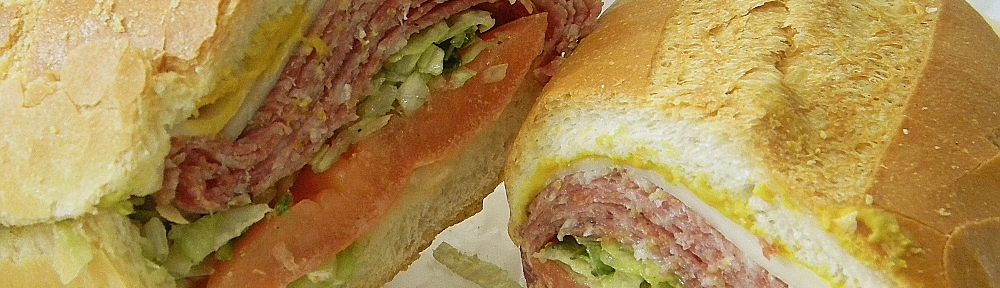
I spoke a bit about authenticity and neighborhoods here, and more recently I was grousing about a bánh mì I felt was overpriced. What today’s post goes to show, though, is that neither location nor price are legitimate markers of quality. They may be clues, but in the end only in trying the sandwich can one find its true measure. King Egg Roll is on the Vietnamese side of San Jose, and the sandwiches are a steal at $2.50 each. The problem, though, is that they just aren’t that good.

The bánh mì is somewhat unique in that as a concept it possesses both a very high ceiling and a fairly high floor; there exist truly bad bánh mìs, but they’re somewhat rare. The sandwiches at King Egg Roll aren’t bad, they just aren’t good. As you might surmise from the name, sandwiches aren’t the main attraction at King Egg Roll. Fried rolls and shrimp balls get top billing, and sandwiches appear to be an afterthought. Perhaps someone took the high floor concept for granted, and figured any old sandwich they slapped together would excel. That wasn’t the case, but it’s a testament to the sandwich (as a concept, not in this example) that I still left King Egg Roll satisfied. The BBQ pork was a bit dry, and the shredded chicken not particularly flavorful, but a bit of chili sauce gave both some extra kick. Altogether, it’s just tough to go wrong. For $2.50 you get a balanced sandwich on a crusty roll. There isn’t much room in there for complaint.

Bánh Mì Bì – Thanh Huong Sandwich, Senter Rd, San Jose, CA

Bì is dry, shredded pork skin. I don’t recall exactly what the menu board at Thanh Huong said, but I am certain it did not include skin. I believe “Roast Pork” was the title. What I found when I sat down to eat my sandwich was not what I was expecting, but what would the world of sandwiches be without surprises? This was my first encounter with bì, but I was excited to try it. Sadly, my excitement was short lived. I found it to be too dry and too salty, and though I understand those are something like features when it comes to bì, this just seemed excessive. That might be my palate; I’ve come to love flavors from all over the world, but I was raised on distinctly American fare. The texture was interesting, and not in an objectionable way. It’s meat floss, and it has a wispy, fine texture worthy of that name. What seems like innumerable strands come together for a dense, very chewy bite. It’s a product that shows up in a number of Asian cuisines, and I would certainly give it another shot. I’d like to try it outside of a sandwich just so I can get a better sense of how things line up. That’s something I think we take for granted when evaluating the sandwich as a whole. We are generally familiar with our ingredients, and knowing what they taste like independently gives us a better sense of how they relate to each other. Operating in unfamiliar territory, that sense can fade quickly. So perhaps the failure here is mine, perhaps it’s the sandwich maker’s. In the end, the only thing of which I can be certain is what was right there in front of me, and that was a disappointing sandwich.

Bánh Mì Thịt Nguội – Long Phung Sandwich & Food, Tully Rd, San Jose, CA

Long Phung Sandwich & Food is square on the southeast side of San Jose, an area where if you pick a store at random you’re more likely to hear Vietnamese than not. These are the places one goes in search of a fine bánh mì, and it has been my experience that the people in these areas are all too happy to provide that fine sandwich. There are some perils to this, however, and the language barrier is one of them. In most establishments the various sandwiches on offer are clearly delineated in Vietnamese, but the English names are a little bit more hazy. My beloved thịt nướng is sometimes labeled as BBQ Pork, and sometimes as Grilled Pork. In the case of Long Phung, the sandwich was clearly marked as thịt nguội, but the only English description provided was “Pork.” I could inquire after more information, but often the language barrier comes up again. I ordered the pork and went on my way.

As it turns out, thịt nguội means cold cuts. I’m no great fan of cold cuts, and it was interesting to see how they translated to my favorite sandwich. The meat was flavorful and moist, some with the more tender texture of ham and some more firm, as you might see in a salami. As for what kind of bánh mì they made, it was about what you’d expect. The baguette and vegetables were passable but not the best I’ve ever had, and it didn’t seem to me that the meat really had the chewy tenderness I look for. I phrase that personally for a reason. This is a popular filling for a bánh mì. I’ll touch on this later this month, but the more bánh mìs I eat the more I come to accept that other people might value different things. In the final analysis, that’s about where this sandwich stacks up. It wasn’t bad, but it just wasn’t for me.

Revisited: Poor House Bistro, San Jose, CA

San Jose’s Poor House Bistro was previously featured here, and today’s post doesn’t have a lot to add beyond the description of two more sandwiches. Not all sandwiches need be philosophical questions, I suppose. The sandwich featured above is the BBQ Shrimp Po’ Boy, which is billed as New Orleans sauteed shrimp in a “spicy” and tangy sauce. I’m not sure why “spicy” is in quotes, but sometimes descriptions of sandwiches can be a bit screwy. In this case, what the description really needed was “peppery,” as that’s the best way to describe the sauce. I prefer my BBQ smokey and a little bit sweet, with the heat playing in the background. That’s not what I found in this sandwich, as vinegar and hot pepper took the foreground. Some folks may find this to be exactly what they’re looking for, but it just wasn’t for me.

The Cochon de Lait Po’ Boy, on the other hand, is much more my speed. A pile of slow roasted pork with the standard cabbage, tomatoes, and pickles, this was delicious. It was also deceptively filling — that pork may not travel to the outer edges of the sandwich but there’s plenty of it. It’s rich and it’s juicy and by the last few bites of this sandwich I found myself more than sated. The cabbage provided a pleasing bit of crunch to counter things, and nothing in the sandwich provided a strong enough flavor to outweigh the pork, which had a decent portion of garlic to the flavor. All in all, this was a well balanced, delightfully savory sandwich, and anyone craving a po’ boy in the bay area could do a whole lot worse than this one.